5 Things We Learned: Chicago Fire 2, Toronto FC 2
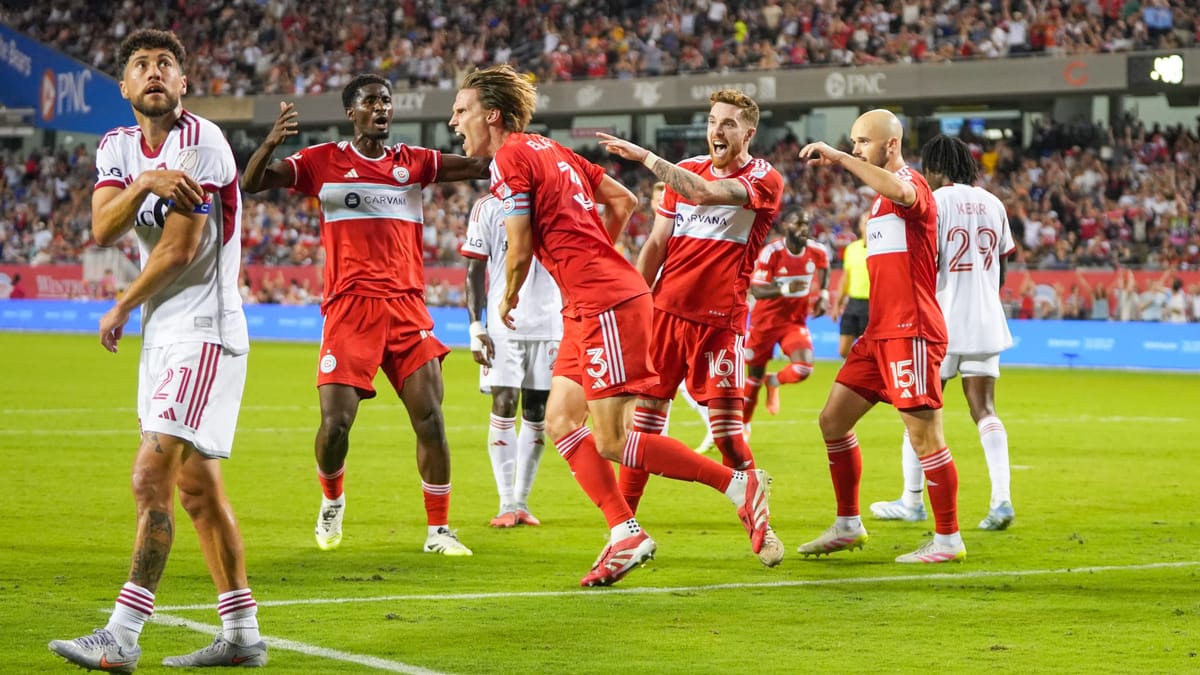
In their last home game of the season, the Chicago Fire played a game that started off slow but had a thrilling end – even if it isn’t one that Fire faithful would have hoped for. Here are five things we learned from their 2-2 draw with Toronto FC.

1. Jack Elliott is the captain for a reason
For the first few games of the season, Gregg Berhalter gave Kellyn Acosta the armband. Berhalter had long known the midfielder, relying on him through qualifiers and bringing him to play for the U.S. Men’s National Team in the 2022 World Cup in Qatar. As Acosta’s minutes dwindled, however, Jack Elliott was named captain.
At first blush, Elliott may not have been an obvious choice: The Englishman is relatively soft-spoken in interviews and was just playing his first few games with the Chicago Fire after leaving the Philadelphia Union.
In retrospect, Berhalter knew what he was doing: Media released by the team makes it clear that Elliott is more than capable of giving fiery locker room speeches. His performance on the pitch last night, however, perfectly encapsulates how the former West Virginia Mountaineer leads by example.
Elliott’s night got off to a terrible start when, instead of a sliding clearance, he deflected the ball into the back of the Fire’s net, putting the team down 1-0 before Toronto managed a single shot, let alone a shot on target. After the game, Berhalter was quick to point out that even if it was Elliott who deflected the ball in, positional issues in beforehand gave Toronto the chance to cross the ball in the first place in the first place, but it still was still a bad look for the center back as the goal put the Fire behind for the first time since September 13th.
In that situation, many players might have retreated, becoming too focused on not making additional mistakes to stick to the game plan. Not Elliott. The Fire captain scored a second-half brace with two headers that put his team ahead until a dagger at the death forced the team to settle for a draw. More on that in a minute – but let’s focus on Elliott.
After the Fire’s first goal, with the game tied 1-1, Elliott also caught up with DeAndre Kerr for an open-field tackle. A VAR review later on a penalty that was called in the Fire’s box again showed that the center back made a clean play.
Where many players would try to overcompensate for an early mistake, the Fire captain retained his composure, made solid defensive plays and had the second multi-goal performance of his career. That’s the kind of poise that the team will need to display as they look to the playoffs.
Here’s what Berhalter had to say about the man he gave the armband to for the bulk of the season: “Jack is a competitor, and, you know, he wants it more than anyone here. So, I think that on the first goal, we'll attribute a lot more than just his positioning, but he competes, and he really helped the team in a big moment to get two goals, and we were really close to getting all three points…. but Toronto tied for the eighth time in a row.”

2. The Fire are learning lessons, but still have more to learn the postseason
The Fire came into this game on a three-game winning streak against playoff teams – two of whom had legitimate Supporters Shield aspirations until they played the Fire – and hadn’t trailed since the final whistle in their defeat to New York City on September 13.
That means that this matchup, against a Toronto FC team that had been eliminated from the playoffs and hadn’t won a game since July 16th, had all the makings of a trap game.
Ultimately, it was: The Fire conceded at the death, costing the team two points – something previous editions of the Fire have done with far too much frequency but which this team had avoided since their matchup against Atlanta in July – and now the Fire have to get a fair bit of help from results around them to make it into the first round directly instead of having a likely matchup against the Crew in the wildcard round.
If this had been a playoff game, that would have sent the game to PKs – more on this in a bit but for now let’s just say it’s not an area for great confidence for the Fire – but this game, despite an opponent that isn’t going to be in the second season, also offered good lessons for a Fire team hoping to punch above its place in the standings in the playoffs.
Despite not winning a game, Toronto have been good on defense – particularly of late. Miami and Columbus can score goals, but, in a way, those are the Fire’s kind of games: The Fire can score too – in fact, they’ve scored almost as much as Miami – and arguably, the Fire’s defense in recent months has been better than either of those opponents.
Toronto has been compact and hard to play through and hadn’t conceded more than a single goal in the seven matches before they met the Fire. That’s the kind of defense that the team will need to learn to play against – much more than a team like Inter Miami’s, however much magic Messi might be able to conjure up – if they want their postseason to be a long one.
With most of the Fire’s roster having never encountered the MLS Playoffs before, there was always going to be a learning curve. The Fire learned some of the lessons here – the come-from-behind nature of the game and using set pieces to their advantage proves it – but still have a lot more to learn, as the late goal shows.
Once again, the Fire’s gaffer, Gregg Berhalter, to close us out on the topic: “I think there are a couple of lessons to take. I think the first one is, you know, we're very average when we don't bring the required energy and work rate… And then you see the second half, the difference in how guys are getting back and recovering and getting into position. So, you know, I think overall we'll learn a lot from this game, and it will help us moving forward.”
If the Fire learn those lessons, their chances of making their trip to the postseason a lengthy stay increase considerably.
But speaking of that last goal the Fire conceded….

3. Brady can save a penalty kick
Chris Brady has been one of the Fire's most reliable players over the last three seasons since becoming the team's #1, but one thing has been a constant – he just could not save penalties. Brady has faced a whopping 28 spot kicks at the first team level in his career, but he has managed to save just 2. That number doesn't include the only shootout of his career, an 11-round slugfest against Puebla in the 2023 Leagues Cup in which he did not save a single kick (though he did score his own).
Saturday's match against Toronto saw that second penalty save, even if it didn't quite end the way he would have hoped. The 21-year-old managed to keep Djordje Mihailovic's penalty from finding the back of the net, but only temporarily, as he parried it straight back to Mihailovic, who scored.
It was not a good penalty-saving technique as he failed to smother the ball or parry it wide, but there is some reason for optimism. For both the MLS Wildcard Round (of which the Fire have a 74% chance of being in) and the best-of-three First Round, all games that are level after 90 minutes would go straight to penalties. In a shootout, there are no rebounds, no second chances... and Brady's save against Mihailovic would have stood as a potentially game-deciding moment. It was his first save since denying Petar Musa in week 3, and followed up successful efforts from Eric-Maxim Choupo-Moting, Sam Surridge, Sam Surridge (again), Alonso Martínez, Kelvin Yeboah, Denis Bouanga, and Carles Gil. Furthermore, in the playoffs, Brady would not be facing teams' best kick-takers, but rather players further down the list.
Beyond just the penalty, though, Brady is rounding into top form at the right time. He notched back-to-back shutouts for the first time in 2025 in key wins against Minnesota and Columbus, before making numerous big saves in the 5-3 win over Inter Miami. His September performances earned him a second-ever USMNT call-up, which will give him the opportunity to permanently break into Mauricio Pochettino's pool and also boost his confidence. If the Fire can continue to get the best version of Brady going into the playoffs, they will certainly increase their chances of making some noise.

4. Berhalter is willing to stick with a back five without Franco
In our preview of the match, we called this a “chicken and egg” problem: The Fire had played out of a formation with three centerbacks and two wingbacks during their three wins going into this one. Incidentally, those games were three of midfielder André Franco’s four starts.
So: What caused the wins? The formation shift or the play of Franco, whose ability to control the game in the midfield unlocked the Fire in ways we hadn’t seen on a consistent basis until his arrival?
With the Fire playing, once again, with a center back trio – Jack Elliott, Sam Rogers and Joel Waterman – but without André Franco, who suffered an ACL tear, rendering him out for the season, it felt like we might finally get an answer.
Arguably, a draw makes the natural experiment void – neither a win nor a loss to prove or disprove the hypothesis – but looking at the run of play, it was clear that the Fire weren’t creating the key moments the way they were with Franco’s presence.
What we did learn, however, is that Berhalter was willing to stick to that formation, even without the conductor, the player who set the tempo, he had in Franco.

Honestly? It didn’t work out great: In the first half, the Fire were, in the words of Berhalter “average,” with “no movement, no running, no moving off the ball. The first ball is a shame.”
Against Toronto, who were far more of a defensive threat than one on offense (after all, the Fire’s own goal was conceded before Toronto had a shot on net), it would have made sense to switch to a back four in the second frame: Take out a defender, put another player farther up the pitch and try to rely on the Fire’s offensive talent to break down Toronto’s defense.
There were subs at the start of the second half for the Fire, but the formation didn’t shift: Instead, it was Brian Gutiérrez giving way to Jonathan Bamba and Djé D’Avilla going off for Sergio Oregel Jr. Gutiérrez played in similar positions to Bamba, and although the Fire didn’t started having considerably more pressure, nothing looked close to being clinical and the Fire remained behind.
Then Berhalter went to his bench again, taking off center back Sam Rogers and putting on Jonathan Dean. Keeping Maren Haile-Selassie, who had started in the right wingback role, on the pitch did change the formation for the Fire, putting more numbers forward.
The Fire’s first goal came ten minutes later.
Was that the death knell of the Fire’s time with playing three center backs? Honestly, at this point, just pretend that this ends with the shrug emoji, but now we at least know that Berhalter was willing to try, even without Franco, who had been a key part of the formation’s success.

5. Zinckernagel's season enters the history books
Has Philip Zinckernagel had the best individual season from a player in Chicago Fire history? The stats argue yes, because on Saturday, he surpassed Nemanja Nikolić to claim the team record for most goal contributions in a single MLS season. The Dane had both assists on Jack Elliott's goals, bringing his assist total (including secondary assists) to 15. That, combined with his 14 goals, brings his total G+A up to 29, which is the sixth most in MLS this season; the other five players ahead of him could very well be the five MVP finalists – Lionel Messi (41), Anders Dreyer (35), Dénis Bouanga (32), Evander (31), and Martín Ojeda (30).
Zinckernagel probably won't claim an end-of-season award league-wide. Messi will almost certainly win the MVP, and because of that, Dreyer will likely slide into the Newcomer of the Year discussion. Even Best XI will be tough given how many of the other top players play in similar positions and on better teams. Nonetheless, it takes nothing away from the winter signing who has exceeded fans' expectations in MLS.
A statistician will also tell you that Zinckernagel has dramatically overperformed his expected goal contributions. In fact, he has exceeded his Expected Goals tally more than anybody else in the league, managing to score 14 times from just 5.68 xG. That does suggest that he has scored plenty of unlikely goals, but it also shows he has been clinical, and adds to the legend of his incredible 2025 season. He has stayed hot since the All-Star Game and is continuing to find consistent form heading into the postseason.
With big elimination games on the horizon, the Fire must now hope that their #11 can continue to perform in this way. If he can, the debate over whether he has had the greatest solo season for a Chicago player might kick off.