5 Things We Learned: Philadelphia Union 2(4) - Chicago Fire 2(2)
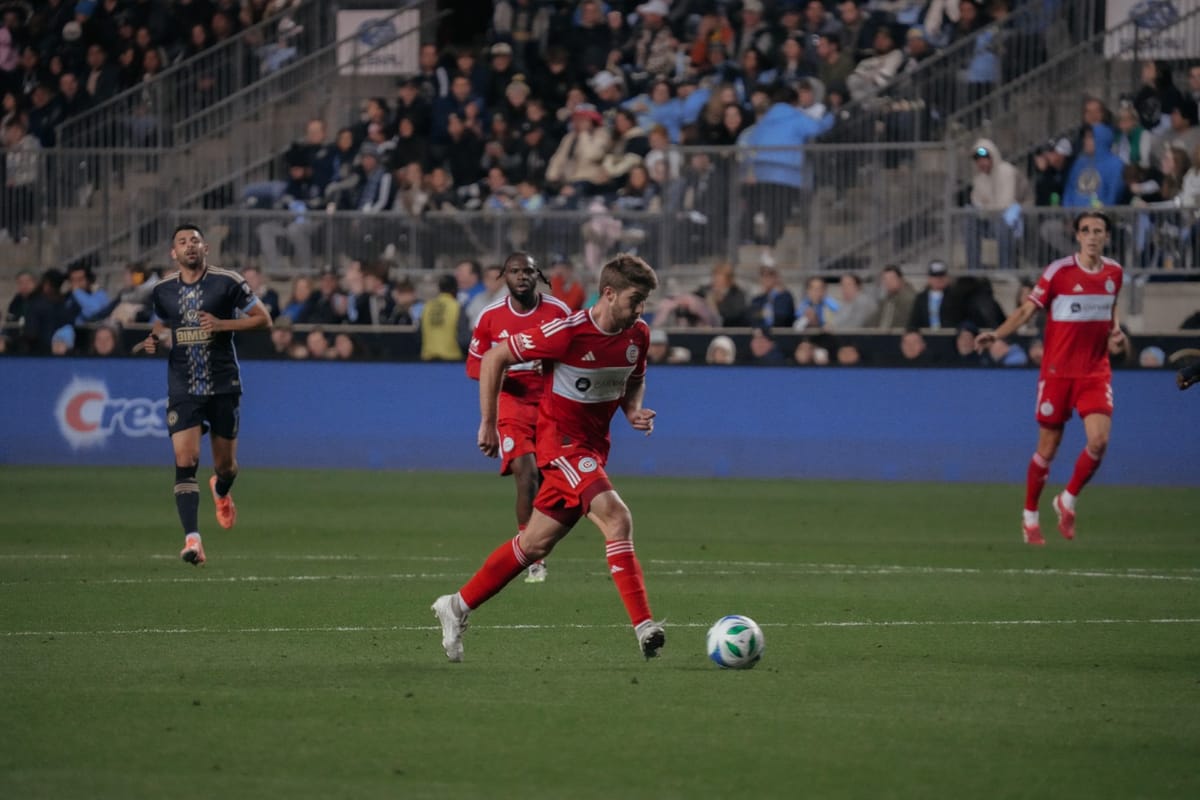
- After an eight year interval without a playoff game, the Chicago Fire played their second postseason game in four days, this time on the road in Chester, Pennsylvania as they took on the Supporters Shield-winning Philadelphia Union in game one of the best-of-three series.
Both teams were held scoreless for most of the game, but fans got to see four goals, leading to a penalty shoot out that where the Fire came up just short.
Here's five things we learned from the Fire's first road playoff game since 2009.
1. The Chicago Fire can hang with Philly
After Wednesday’s win over Orlando, Fire Head Coach Gregg Berhalter said that ̄the Philadelpia Union “kicked our butt” in the two regular-season matchups between the two teams. On Friday, when he was told that Bradley Carnell, the Union’s head coach, complimented the strength of the Fire’s attack, Berhalter said he didn’t “know what Bradley’s saying. We didn’t score a goal against them” in those two matchups.
Look: Failing to score against the 2025 edition of the Chicago Fire in three consecutive matches would have been a feat, and maybe it wasn’t likely that that would happen, but in reality, they showed that they can stand toe-to-toe with the Supporters Shield winners.
They held the Philadelphia Union scoreless for just shy of 70 minutes, and even if they did concede twice in short order, Jonathan Bamba cut into the Union’s lead less than 10 minutes later – the first goal for the Fire against the Union in 2025. Less than 10 minutes after that, the Fire had leveled it.
Falling in penalties isn’t the result the Fire wanted after battling back, but Jack Elliott – goal scorer, and looking more and more like Captain Jack with black bandaging the stitches above his eye after Wednesday’s injury – said after the game that the despite the ending, the game was “good confidence for us. I mean, I think we matched them very well throughout the game, and, you know, really limited the chances they had.”
That’s a fair assessment of the way the game played out, where the Fire and Union were almost level on expected goals. The Union had more shots; the Fire had more shots on target – due in no small part to the defensive performances from the Fire, taking away good angles and blocking chances.
2. But Berhalter’s strategy has real tactical tradeoffs
Berhalter tried to flip the script on the Philadelphia Union, whose tactical strategy is based around quick transition moments. Find a small mistake, turn it into a big one, and make the other team pay. The Fire, meanwhile, have typically preferred playing with the ball, using it, in the words of the Fire gaffer, “to destabilize the opponent,” creating openings and overloads by drawing teams out of their structure, rather than the Union’s strategy of letting the teams make their own errors – and then making them pay.
Instead, in game one, the Fire made it clear that they wanted to let the Union have the ball – not as often as they’d want, but way, way more often.
On one hand, it worked: Not only did the Union not score a goal until the 70th minute, a number of Union players seemed lost at sea for much of the game. The Union’s fast-counter tactics are made to make opponents uncomfortable – but ultimately, that’s what the Fire succeeded in doing against their opponents.
Great, as far as it goes, except the Fire didn’t create much going the other way, either. The strategy kept the Fire from losing to Philadelphia but it didn’t do a lot to help beat them either.

The Fire had two goals against Inter Miami – including the one from Justin Reynolds in the 80th minute that sent the Fire into the playoffs for the first time since 2017 – without Franco playing with a back five. That game was a wild, wide-open affair, however, and, let’s be honest: From the front, Inter Miami bring the party, with an attack featuring Lionel Messi who has been on a tear in 2025. But the back? The mullet effect is ruined: Miami are not taking care of business there, and tired legs, with Miami’s hectic September schedule and aged corps, were certainly a factor.
Since those two goals, the Fire have played out of a back five, against Toronto FC, the New England Revolution and now, the Philadelphia Union. Since then, they have failed to score a goal in that formation. In games where the Fire started with a back five, Berhalter switched formations, and the team found the back of the net. The change came in the 61st minute against Toronto and the team scored two goals afterwards. Against the Revs, the switch came at half. Against the Union, it came in the 73rd minute.
Doing the math so you don’t have to, that’s 210 minutes over that stretch when the Fire failed to score. They gave up three goals in that span. Over the same span, including the game against Orlando, when the Fire played a back four all night, the team scored nine goals over about the same number of minutes, once stoppage time is factored in.
The Fire also did concede three goals over that interval, but that’s the same number they managed playing three center backs.
The verdict seems to be in: The back four works better when the Fire are without Franco. That is, at least, unless you consider that….
3. Brian Gutiérrez is a playoff baller
Look, the only places that Brian Gutiérrez featured in the boxscore on Sunday were his successful spot kick and his yellow card deep in second-half stoppage time. But he still was a literal game-changer against the Philadelphia Union.
When he and Sergio Oregel came on in the 73rd minute, the Fire shifted formations to a back four, taking off center back Sam Rogers, leaving Joel Waterman alongside Elliott, in exchange for an additional midfielder. Yes, the Fire soon gave up a goal, but seven of the Fire’s 13 total shots – and both of the Fire’s goals – on the night came after Gutiérrez and Oregel were on the field.
Oregel should get credit for his play on the field, where he was showing his ability to move the ball forward. (He should also receive the blame for a pointless red card, with Berhalter saying that he was “disappointed with Sergio because he lost his head. And he's not a fighter. To do something like that now puts him out of this game, hurts the team.)
However, it’s Brian Gutiérrez that really needs the shout out here: Against the Union, he was dynamic, asking questions of Philadelphia’s much-vaunted defense that the Supporters Shield winners didn’t seem to have answers for.

It was the second playoff match of Gutiérrez’s MLS career and the second match where he was impactful. Small sample size? Absolutely. But he did feel like an impactful player for the Fire in the midfield, after Rominigue Kouamé had a decent but overall less impactful outing than Gutiérrez.
Longtime readers – along with listeners of The Bonfire – know that I’ve been critical of Gutiérrez, saying that although his skill levels are off the charts, he disappeared in key moments and hadn’t taken control of a game the way you often need your No. 10 central attacking midfielder to do in this league.
Gutiérrez may not have single-handedly taken control of either of the Fire’s playoff games. He did score the opening goal against Orlando, but that dam felt like it was about to burst for a while – but he has really looked like a difference-maker on the field in the postseason.
A lot of that is due to formation and game state – and Kouamé remains the midfielder with the most complete game on both sides of the ball of Berhalter’s available options – but the fact is, Gutiérrez has earned a start on Saturday, especially when you consider….
4. Zinckernagel’s absence is another body blow
The undercurrent through the entire game was the late, unexpected absence of Phillip Zinckernagel, the Fire’s leading scorer and the driving force of much of their attack. Zinckernagel was taken out after lineups were announced and although he was listed as being on the bench, he was later photographed in the box given to Fire owner Joe Mansueteo.
https://twitter.com/ufcolin/status/1982596251893076000
After the game, Berhalter disclosed that it was an oblique injury. The prognosis at the time was uncertain, but would still make his return for this round doubtful.
Zinckernagel’s status as a late scratch meant that the team wasn’t really able to do any gameplanning accounting for his absence and wasn’t able to build a tactical plan – or put together a lineup built without him.
In the end, the only real shift was moving Jonathan Bamba to the right-hand side and putting Maren Haile-Selassie on the left. Bamba looked effective from the right-hand side, begging the question of whether flipping Zinckernagel and Bamba would be worth trying at some point, but in the end, the Fire were playing without one of their best attackers – and looked like it.
They didn’t really manage to produce much in the first half against the Union. Some of that was game plan (see above) but doubtless, the plan was for the Fire to be deadly in individual moments in the attack – something they weren’t really able to do without Zinckernagel until they changed the formation.
Early in the season, the Fire’s midfield was racked with injuries, but since then, the Fire were relatively healthy for most of the season – especially since the injury-prone Carlos Terán was moved onwards and replaced with the more durable Joel Waterman in the lineup. That all changed, though, with André Franco’s injury against Inter Miami, which paused a late-season surge for the Chicago Fire. It isn’t naïve to think that with Franco in the lineup, the pair of 2-2 draws that the Fire had in his absence might have both been wins – and the FIre would be looking at a fifth place finish and a series against Charlotte rather than having had to play through the wildcard.
That’s not the world we live in, however, and the Fire adapted – but losing Zinckernagel is another huge blow for the Fire.
Despite that, however…
5. The Fire should be confident going into SeatGeek on Saturday

The conventional wisdom is that even though the format says that the game starts level, the team that lost game one of a best-of-three series has to approach game two differently: They’re facing elimination; the opponent has two chances to get one win.
I’m not really sure how much that applies to this series. Based on the previous results alone, it wouldn’t have been totally irrational to expect a lopsided scoreline. After all, as Berhalter pointed out, the Fire failed to score against the Union in the two previous meetings between the sides this season.
It may have taken until the final 10 minutes of regular time, but the Fire notched their first and second goals in a game that was level for the vast majority of the time on the pitch.
The fact that that game came with a late scratch should buoy the Fire, and just the fact that they were able to battle back and level the score against the Supporters Shield winners says a lot about the strength of this team.
The Fire were on short rest, having played midweek, and dealing with an improvised lineup and they still took the Union the full distance. Add in the winds of a friendly – and loud – home crowd at their back and there’s a strong argument that the team should actually be favored on Saturday, living to play another day (a week later, back in Chester).