Chicago Fire inaugurate new Endeavor Health Performance Center: “This is a civic project”
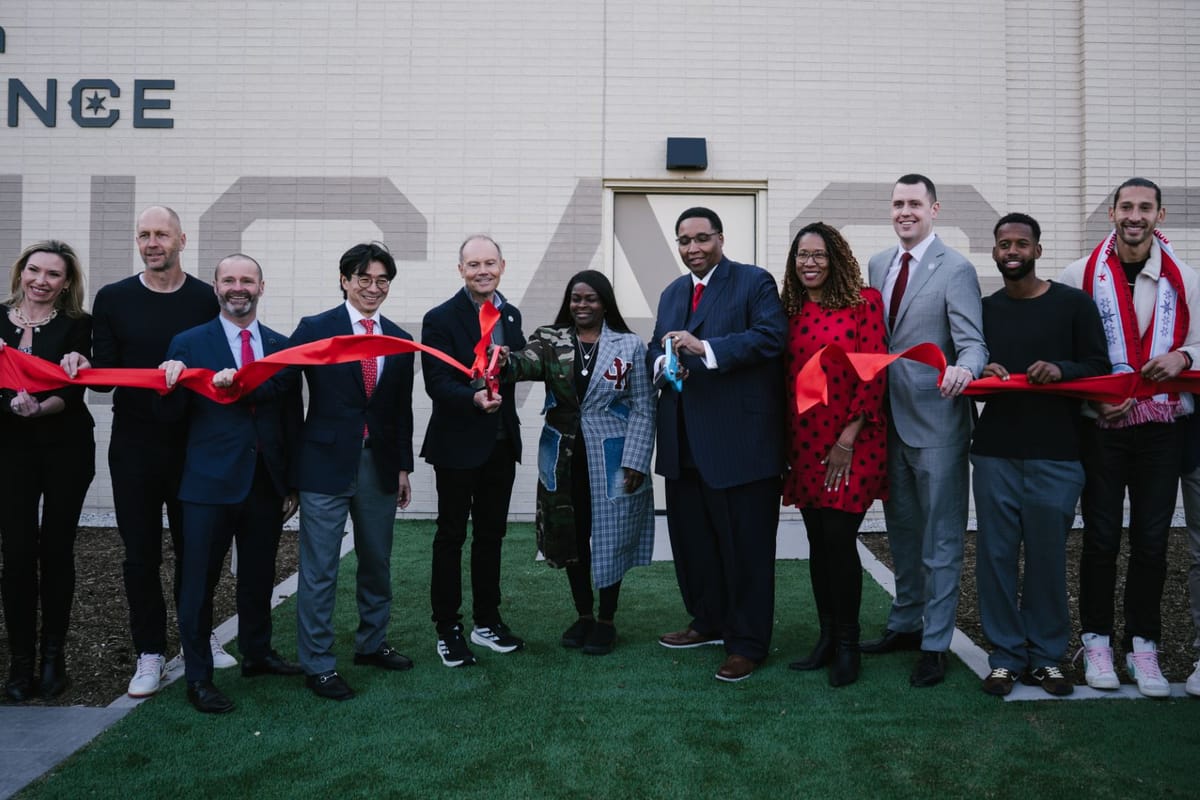
The Chicago Fire hosted sponsors, media and other guests at the official ribbon cutting ceremony for the Endeavor Health Performance Center, the team’s new training facility. The Center represents a $100 million investment for the team and moves the sporting aspects of the Fire first team, second team in MLS Next Pro as well as academy teams to the city five years after team owner Joe Mansueto returned the team’s matches to Soldier Field.
Despite playing games in the city after 14 years at SeatGeek Stadium in suburban Bridgeview, the team’s training facility and sporting staff remained there until this year. That meant that players – and employees – worked roughly five days a week in relatively cramped quarters in Bridgeview, often in spaces that the Fire shared with NWSL’s Chicago Stars and in recent years, the Chicago Hounds rugby team. The new facility therefore represents both a significant upgrade in facilities as well as a consolidation of the team’s sporting and business operations as well as first team games in the city limits.
As might be expected for events like this, speakers included team executives, the owner, corporate sponsors and, since this is Chicago, where the local alderman carries much sway over what is built in their ward, the alderman. Uniquely, however, Mary Bagget, president of ABLA Homes, the housing project that was partly razed decades ago as part of the Chicago Housing Authority (CHA)’s “Plan for Transformation,” a largely failed initiative to replace the city’s public housing stock, also gave a speech from the podium. The performance center was built on land that was once part of ABLA Homes, and is being leased by the Fire under a deal that Dave Baldwin, the team’s president, noted will give the CHA $40 million over the lifetime of the lease.
As part of the CHA’s “Plan for Transformation,” the CHA promised to replace the destroyed public housing units and refurbish the remaining homes. However, the plan relied on private developers to spearhead the redevelopment of the newly-vacant land into mixed income housing, replacing the lost units alongside new market-rate units. The plan failed to deliver on the vast majority of those developments, however, and the ABLA land sat vacant until the lease with the Fire was signed.
For the Fire, the lease, as noted by Paul Cadwell, the team’s senior vice president of community programs, engagement and facilities, who spearheaded the project for the team, was contingent on getting approval of the ABLA residents. “It is the life-changing elements of this project which were agreed upon with the ABLA LAC [Local Advisory Council] that make me most proud,” Cadwell said, “A very robust and comprehensive community investment agreement was memorialized in the lease with the CHA to ensure that this project brought investment to the neighborhood.” Sources have told MIR97 Media that the deal was almost scuttled at some points over CHA’s hesitancy to incorporate that language into the lease – a legally binding document – but the Fire insisted. As a result, the Fire agreed to an $8 million contribution, in addition to the payments in the lease. “The first $4 million focused on the community center, and to build a parking lot for the William Jones Senior Center across the road.” Cadwell noted that as part of the work, ABLA residents will get a basketball court – even though, he said in jest, he “tried to convince them that a soccer field was better,” “the basketball court is what the residents wanted” and will be part of the initial community investment.
The result, as said by Ald. Jason Ervin, was a benefit, “not just for the Chicago Fire but a benefit for the west side of Chicago. And for the residents here in the ABLA community, and I must say… you all have done a great job honoring your commitment, even at odds at times with CHA and the city.” Those sentiments were echoed by Baggett, whose remarks followed Ervin’s.
Baggett thanked the Chicago Fire for “choosing to make our community” their home, saying “your presence here marks the beginning of a new and exciting chapter that we are eager to embrace alongside you. As a community, we thrive when we come together, supporting one another. Chicago Fire’s commitment to innovation, sustainability, and positive impact aligns with our shared values. We are excited about the opportunity that lies ahead. We look forward to collaborating with you all in the months and years that come.” She noted that the terms of the lease “ensure that we’re not left out.” The impact she hoped to see was clear. “Residents of ABLA have not had a renovation in over 26 years… and now we are going to get all 330 of our units with a full gut renovation,” in addition to the community space.
The result was a signed lease with community benefits promised for residents, and for the Fire, a new, state-of-the-art 53,000 square foot facility, which Gregg Berhalter, the team’s head coach and director of football, noted was truly world0class, after having experienced top facilities globally in his time as head coach of the U.S. Men’s National Team. He joked to the Fire players seated in the front row that with a training facility like this, “there’s no more excuses, boys.”
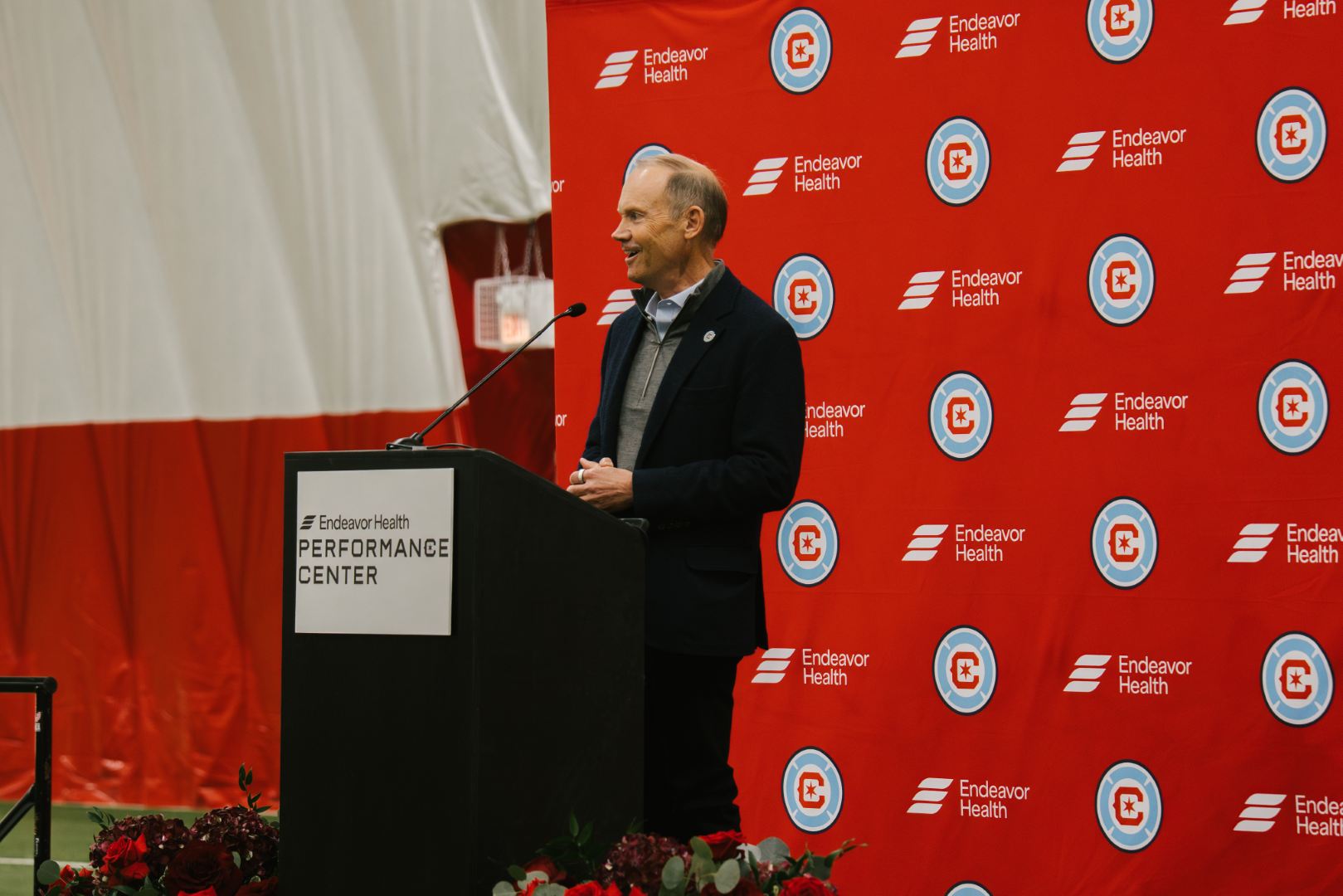
Mansueto spoke about his “huge passion for soccer,” calling it “the world’s best sport.” The first remarks he made about players of it, however, are not likely headlining at Soldier Field, saying that “it’s the best sport for kids to play,” noting the health and social benefits that playing soccer can bring to youth. Instead of touting his investment, he said “one of the things I’m so proud about with the Fire” is “the 15,000 young kids in our youth programs throughout the city. We have another 10,000 adults in our rec leagues,” noting the team also runs soccer clinics in Chicago Public Schools.
“Most importantly,” Mansueto said, “this is a civic project. And if I have one message for you today, it’s that this is a city civic project. This is for Chicago.” Noting the popularity of clubs like Portland and Atlanta, “You see how popular the soccer clubs are in those towns…. And then I looked at Chicago, and that wasn’t the case. Chicago is a world-class city. It deserves a world-class soccer club.”
Because of the new facility, they now have the facility to help catalyze that dream into a reality.