Evaluating Ezra Hendrickson’s Performance as Head Coach

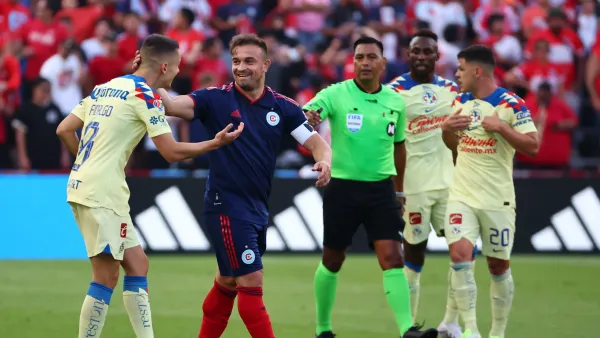
Ezra Hendrickson’s second year as head coach begins with considerably less optimism around the team than during his debut season, leaving many to question how much of the team’s 2022 performance should be placed on the shoulders of the head coach. That year, offseason changes had Fire faithful feeling that a return to the postseason might be finally within reach. Additions to the squad, headlined by global star Xherdan Shaqiri, alongside a new head coach in Hendrickson, one who, unlike his predecessor, came with 25 years of experience in the league as a player and assistant coach, had Fire fans feeling as if Georg Heitz was finally righting the wrongs of his first years as Technical Director for the team.
Prior to the start of the season, Hendrickson certainly seemed to check the right boxes for a Fire head coach, speaking on the importance of developing an identity that integrated the city’s hard-working ethos into the team and playing an entertaining brand of possession-based soccer with a team that would work hard game in and game out. He recognized the talent in the team’s homegrown players, something that had been an issue for the Fire for years, as promising young talents were left to wither on the vine (or, to be more precise, the bench), calling the team’s academy one of the best in the league. Coaching a superstar like Shaqiri? Hendrickson had no worries, citing previous experience as an assistant coach on LA Galaxy teams that featured Zlatan. He even discussed the importance of connecting club and community - even going as far as making a significant donation to the food drive spearheaded by supporters' groups.

Things started off well enough for Hendrickson’s tenure as head coach, as the Fire went undefeated through their first five games with him at the helm, but following that, the Fire went on a winless drought that lasted 91 days - including a heartbreaking loss to 3rd division Union Omaha in the team’s first US Open Cup match since 2019 - before the team managed three points against DC United on June 18th. It’s difficult to come back from three months without a win in a seven-month season, and the Fire spent the ensuing months trying to claw its way back into a playoff spot, only to find their season over well before Decision Day. Given the disappointing results, Fire fans naturally began to wonder what the issues were and if Hendrickson deserved to stay in his role.
Those feelings were only amplified when expansion team Charlotte FC parted ways with their Head Coach Miguel Ángel Ramírez on May 31, at a time when their team had 16 points, and the Fire had 11. Surely, the argument went, if a team in its first year - and with a considerably smaller roster spend - isn’t satisfied with those results, the Fire shouldn’t be satisfied with their position.
The case against Hendrickson’s tenure boils down to this: He’s an inexperienced head coach who seemed unwilling to experiment with the squad or formation: He severely limited U-22 striker Jhon Durán’s minutes early in the season, even as it was clear that the team’s other #9s were struggling to score, he continued to play Shaqiri in a central attacking midfielder role, rather than out wide where he’s spent most of his career in both club and international soccer, going as far as having Shaqiri take practically every corner and offensive dead ball that happened while he was on the field, even as the team struggled to generate real chances off set pieces. In fact, through the season, the only team that played any formation for more than the 1833 minutes that the team played in Ezra’s preferred 4-2-3-1 formation was Austin, at 1886 minutes, well above the league average of 1114 minutes for starting formations. That might all have been well and fine if the team had been winning, but it wasn't, and yet, Ezra stuck to his guns, even as losses mounted.
Yet that argument, while succinct, fails to look at the whole story. The head coach can only play the hand – or roster – that he’s dealt. On top of long-term questions such as whether Gastón Giménez has enough of a skillset to succeed in all aspects of his role as the team’s leading central defensive midfielder, the Fire entered the season with considerable holes in their roster: Offseason DP signing Jairo Torres didn’t make his way from Atlas until May, and he arrived injured (and as a result, never performed close to the expectations for any starter in this league, let alone one who came with a $5m transfer fee), and prior to winger Chris Mueller’s arrival in May, the team started the season had so little depth that Jonathan Bornstein - a defender in his late 30s, who hadn’t played in an offensive role in years - was subbed on at that spot.

Hendrickson was asked about keeping Durán on the bench, even as the team struggled to put the ball in the back of the next, and he explained - diplomatically - that his decision was a result of performance and effort in training. Durán looked raw, even at the end of the season, and English media frequently described him as a “project” on his arrival at Aston Villa in January.
While every club will struggle with injuries, the Fire’s were particularly vexing - Jairo Torres never looked fully healthy on the field, and Przybylko looked like a different player after missing time with a back injury. The team’s back line - one of the bright spots early in the year - dealt with a host of short- and long-term injuries, including a season-ending injury to Wyatt Omsberg who had been having a breakout season playing next to Rafael Czichos.
It’s also worth asking what factors are really under the head coach’s control. The team finished the year with 48 goals against, the 5th fewest in the Eastern Conference and the 10th fewest overall in the 28-team league, and the team also did reasonably well at getting the ball - coming in 9th in the league at winning possession in the final this last season. To the extent that the team had an issue, it was largely with finishing - and as Manchester City manager Pep Guardiola has famously remarked, that’s one part of the game that can’t effectively be coached.
Looking at why coaches are relieved of their duties is also instructive. Ramírez wasn’t dismissed solely because of results - but instead, because of conflicts with the front office and a budding player revolt, with reports going as far as saying that their DP striker would refuse to play on return from international duty if Ramírez remained at the helm. By all regards, the Fire’s locker room is still fully behind Hendrickson - which, if anything, is a testament to his ability to build a rapport with his squad given the difficult season the team faced last year.
The ultimate measure of a coach isn’t results taken in isolation, but rather, if results are falling short of expectations - and this year, many pundits have the Fire near, if not at, the bottom of the conference if not candidates for the Wooden Spoon. More importantly, a coach should only stay if they can actually coach their squad. If the coach is no longer able to organize the squad and get them to respond the way they're being asked to, then the coach has lost his players. Should those things happen, the team should, by all means, explore other options for his position, but until then, a change in coach is just as likely to be harmful and beneficial.