Fire at Orlando: Tactics and Starting XI
On average across the league, MLS teams win about half their games at home and about a quarter on the road, with draws filling in the rest. The Fire are slightly underperforming the road average – it took until their eighth road game of the season for the team to get their first win, and they’re now 1W-4D-3L. Orlando, on the other hand, are drastically underperforming at home, with just one win in nine games – and that win came back on March 23. They’re 0W-2D-4L at home since, and 1W-3D-5L at home overall.
Still, the Fire, for the most recent half of their history, have not been a good road team: Last season’s wins over Portland and Kansas City were the first time the team’s won back-to-back road games in a decade. It’s very much something they’d like to repeat in Orlando, which last year, was the one blemish on an otherwise perfect record that saw the team rack up five wins, including the aforementioned victories over the Timbers and Sporting KC before losing to in Orlando and returning home to win three in a row at home.
With the Fire perched precariously – two points out of a playoff spot and yet two points removed from the bottom of the conference – they’d` very much like to pull off the dub in Orlando that eluded them last year.
Orlando won’t make it easy: despite their dismal record in front of the home crowd this season, they’ve made tactical switches and players that have been drastically underperforming are starting to show signs of life.
Note: As the Fire faced Orlando earlier this season,, this is an abbreviated article focused on updates. For an overview of Orlando’s tactical approach, check out our earlier piece.
Orlando
Overview
When we last checked in on Orlando, I’d said that they were very much reverting to the mean after greatly overperforming their underlying numbers last year: They scored 16 more goals than they conceded, while their expected goal differential (xGD) was just +1.6.
I’d said it’s been the mirror image this year and that’s still the case: Their expected goal differential is -1.5, under what last year’s was but pretty close, while in actuality, they’ve allowed ten more goals than they’ve scored.
Part of that is because starting GK Pedro Gallese has gone from one of the most reliable performers in the league to a liability. That won’t be a factor on Saturday: Gallese is with Peru for Copa America, and Mason Stajduhar will take his place; he’s looked to be on the better side of decent since starting between the sticks for Orlando.
The rest, though, has been largely because Orlando’s key performers outside of Duncan McGuire haven’t played like key performers.
What has Orlando done to change things around?
Head Coach Óscar Pareja hasn’t been taking the results lying down, and last week, he shifted his team into a 4-4-2 shape after a lengthy stretch where the team played three in the back.
They played Charlotte to a midweek two-all draw, but both their goals came after Orlando were up a man following a straight red card to Charlotte’s Scott Arfield, so I’m not sure that you can take too much from that result.
Against LAFC last Saturday, however, they looked pretty good, using Duncan McGuire as the primary target striker and having Luis Muriel responsible for passing the ball into the box and being a creator, occupying the space that Maren Haile-Selassie has been for the Fire, but with a role that is a lot closer to what the Fire get from Brian Gutiérrez.
Muriel certainly has the ability to lay off a beautiful pass:
https://twitter.com/MLS/status/1802148205242499253
That’s allowed Facundo Torres to be a deeper-lying midfielder at times, while joining the attack like a winger when the opportunity allows.
It honestly looked pretty decent against the team that has the best underlying numbers in the league.
What didn’t look good was how wasteful they were with shooting: Martín Ojeda’s goal was the Lions only one of their 19 shots that landed on target. Shooting high and wide will add to your xG, but it won’t nag you any goals.
Still, as a general rule, if a team is playing well and shooting, the goals will come sooner or later.
Who Will Be in the Starting XI for Orlando City?
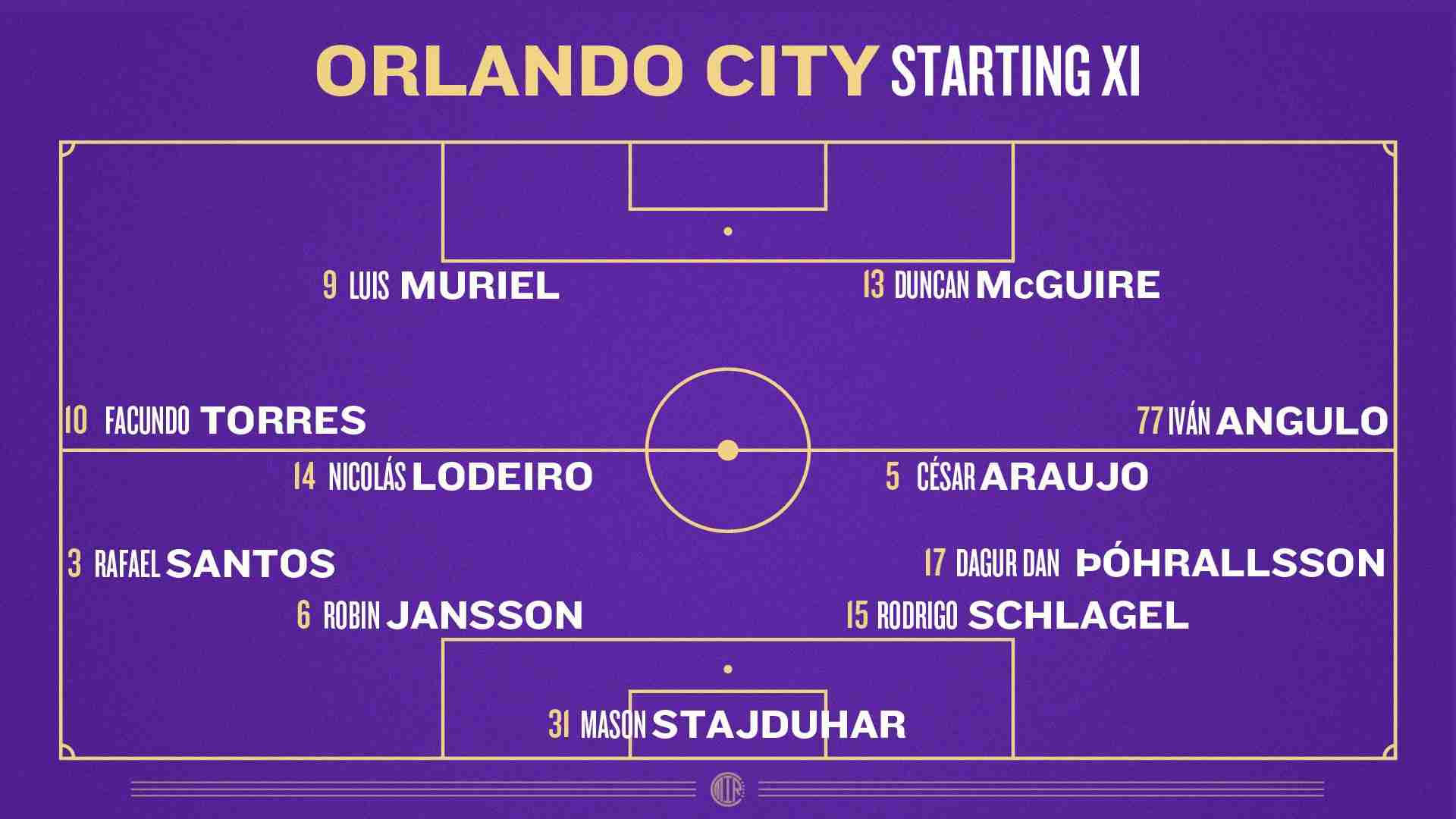
I can’t see Pareja abandoning the 4-4-2 that’s had his squad looking better than they have all season, but he’s also in somewhat of a bind: On Wednesday, he made just one change midweek from the lineup that started against LAFC last Saturday, bringing on Felipe in lieu of César Araujo in the central midfield.
Key Orlando City players, including 35-year-old Nicolás Lodeiro, have already played 180 minutes in the past week and the team has a short week, with their next game in Harrison, NJ against the Red Bulls next Friday. Facundo Torres has also played 180 minutes, and McGuire and Muriel have both played a full 90 minute game in the past week while starting and being subbed off in the other.
In front of a home crowd, however, and with the team desperately needing to give their fans something to cheer for, I think Pareja has to go for it. Throw caution in the wind, field the strongest XI you can, and worry about next week’s match later.
Chicago Fire
Will the Fire be able to keep scoring?
Deep tactical analysis here: Scoring goals really helps you win soccer games. The Fire are 4W-1D-0L in matches where they’ve scored more than one goal this season.
The issue, though, is that there’ve been too many matches where they haven’t. One reason why: Early in the season, the team was working primarily out of what felt like a mid-block, and when the team did win the ball, what would typically happen is the ball would be carried or passed wide, that player would cross it into the box where there would maybe be two players.
I’m generally not a fan of being cross-dependent on offense – the defending team is likely to have more bodies in the box than you do, and even ignoring that, you’re taking possession and turning it into a 50/50 ball – but they do have their place.
The Fire’s issue is that they just weren’t getting nearly enough numbers into the box, whether to get on the end of crosses, win second balls, or generally do the kinds of stuff that wins you a soccer game.
When the team switched to three center backs (I’m not going to name a formation here – more on that below), they’ve also switched from being a possession-based team that tries to build up through the middle of the pitch to a team that plays a higher press, trading possession for field position and generally getting more players higher up the pitch.
That’s an almost instant way to raise a team’s floor, and one thing it’s done is help the team get more numbers up the pitch. I asked Frank Klopas about it midweek, and he said “We always need at least three in the box, that’s for sure… when we do move up as a unit better and we get more numbers, then we are better prepared to counter-press when we lose that initial first cross and stuff like that. I think that's been a big part. I think we have been very dangerous in these games, moments where we counter-press, win the ball closer up the field, and have numbers closer to goal and quickly transition, and with crosses, cutbacks, shots on goal.”
It’s been working:
https://twitter.com/ChicagoFire/status/1802146771927277693
The Fire lost possession but had the numbers to win the ball back deep in Toronto’s end. When the ball was crossed into the box, the Fire quickly had four players in the box with Acosta standing just outside and Maren Haile-Selassie in an advanced position.
That spread out Toronto’s defenders and meant when the ball came out, it was a Fire player – Mauricio Pineda – who was first to connect, scoring his first goal of the season. It wasn’t a coincidence that he and fellow defender Allan Arigoni scored against Toronto. The team’s made a tactical switch and it’s been getting more players involved in the attack.
Did the Fire switch formations against Toronto?
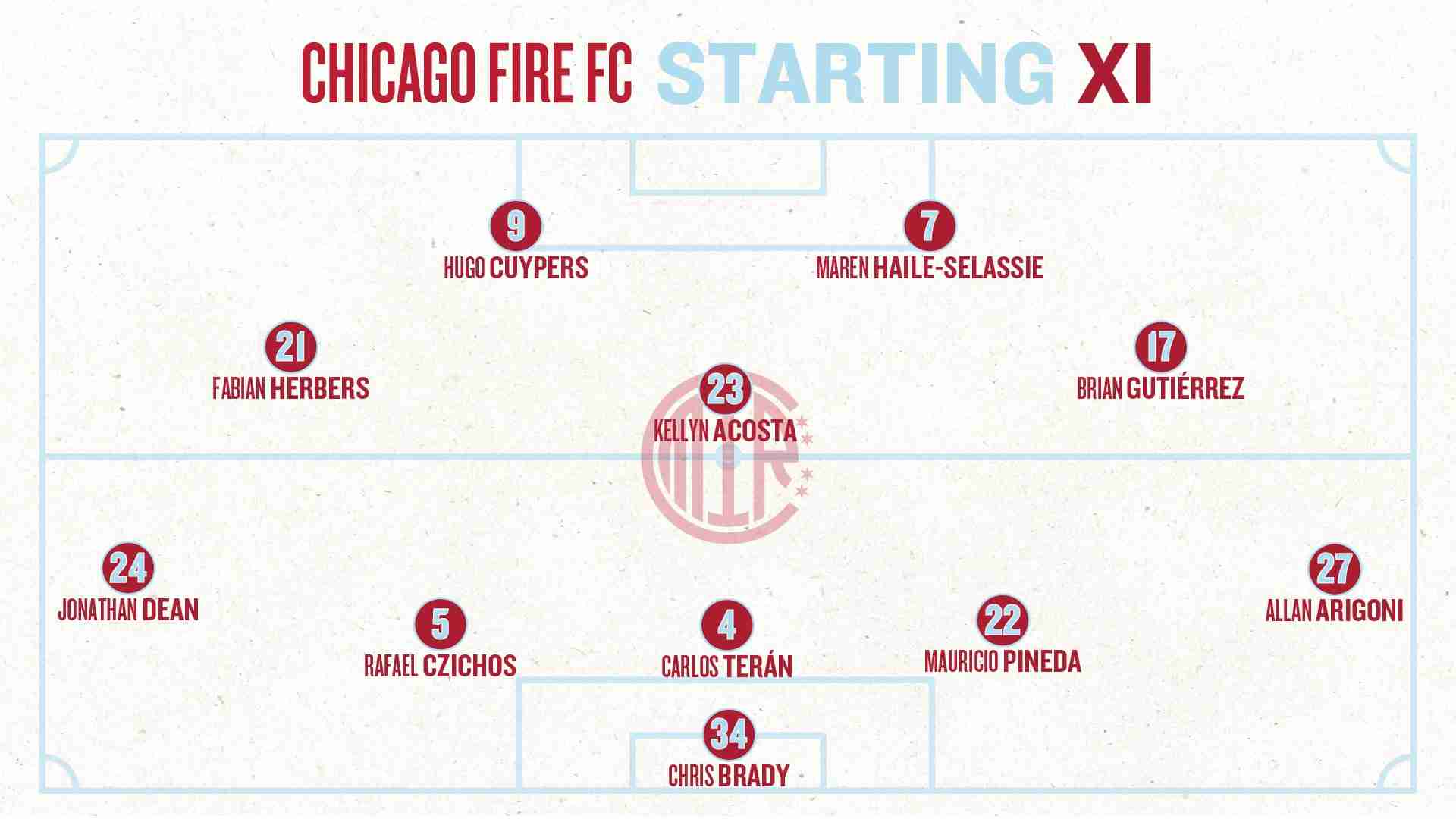
Since Xherdan Shaqiri left for national team duty in Europe and the team started playing three center backs, the team’s been listed as playing a 5-3-2.
Against Toronto, the Fire were listed as playing out of a 3-4-2-1, mirroring the host’s midfield quartet, with three center backs (including Arnaud Soquet, filling in for Rafael Czichos who didn’t get back from his Green Card appointment in time to join the team) forming the backline and a midfield quartet comprising Allan Arigoni, Fabian Herbers, Kellyn Acosta,and Jonathan Dean.
Ahead of them were two attacking midfielders – Brian Gutiérrez and Maren Haile-Selassie – and a single forward in Hugo Cuypers.
Here’s the thing: It’s the same formation in every sense but the one on paper. Arigoni and Dean didn’t suddenly become midfielders. Maren Haile-Selassie’s average position against Toronto, when he was playing, nominally, as a midfielder, was a bit higher than it was against the Galaxy, when he was playing as a forward.
I expect Frank Klopas to maintain the same formation against Orlando, though against a midfield four, it wouldn’t surprise me if the Fire nominally played out of a 3-4-3 or 3-4-2-1 again, with Czichos returning to the XI and no other changes.
One wrinkle the Fire will have to face, though, is Orlando’s attacking talent. Even though Facundo Torres and Luis Muriel haven’t been performing well this season, they’re still dangerous, and have looked more dangerous in recent matches. Against both the Galaxy and Toronto, the team has lucked out in that key offensive players haven’t been fit to start.
That’s meant that the opposition has really had one offensive focal point – Lorenzo Insigne last week, Riqui Puig for the Galaxy – that Carlos Terán could be tasked with man-marking when they enter the box. Given the number of matches they’ve played, Orlando may have to rotate, but if they don’t, it means that there really won’t be one singula focal point for the attack.
Now, for the most part, Orlando’s attack has been fairly toothless, and it might not be an issue, but it does add a tactical wrinkle the Fire haven’t had to deal with as they’ve notched two victories.
The teams have identical records so far. Last season, Orlando was the one blemish in an otherwise stellar stretch for the team. This season, the Fire really do need to start getting results if they’re fortunes are going to change, while Orlando are trying to fight a drop off like what we saw from Austin. It should be an interesting one, but it should also be one the Fire feel they can handle.