Fire Roster, Cap Situation Ahead of the Summer Transfer Window
With the MLS Secondary Transfer window set to open July 24th, the Chicago Fire and other MLS teams can soon bring in players from around the league and around the world.
The window stays open through August 21st. As a reminder, teams can announce deals at any time, including before the window opens, but players cannot be registered unless the window is open. Similarly, a deal being announced does not mean that a player will be available in the next match: Foreign players coming from abroad must also receive visa clearance, a process that can take days or even weeks. After the window is closes,
Player transfers, loans and sales within MLS (or to other U.S.-based leagues like USL) must happen while the window is open, while sales and loans abroad can happen at any time while that country’s transfer window is open. For most European countries, that is September 1st this year. The window in Türkiye and Mexico is open until September 12.
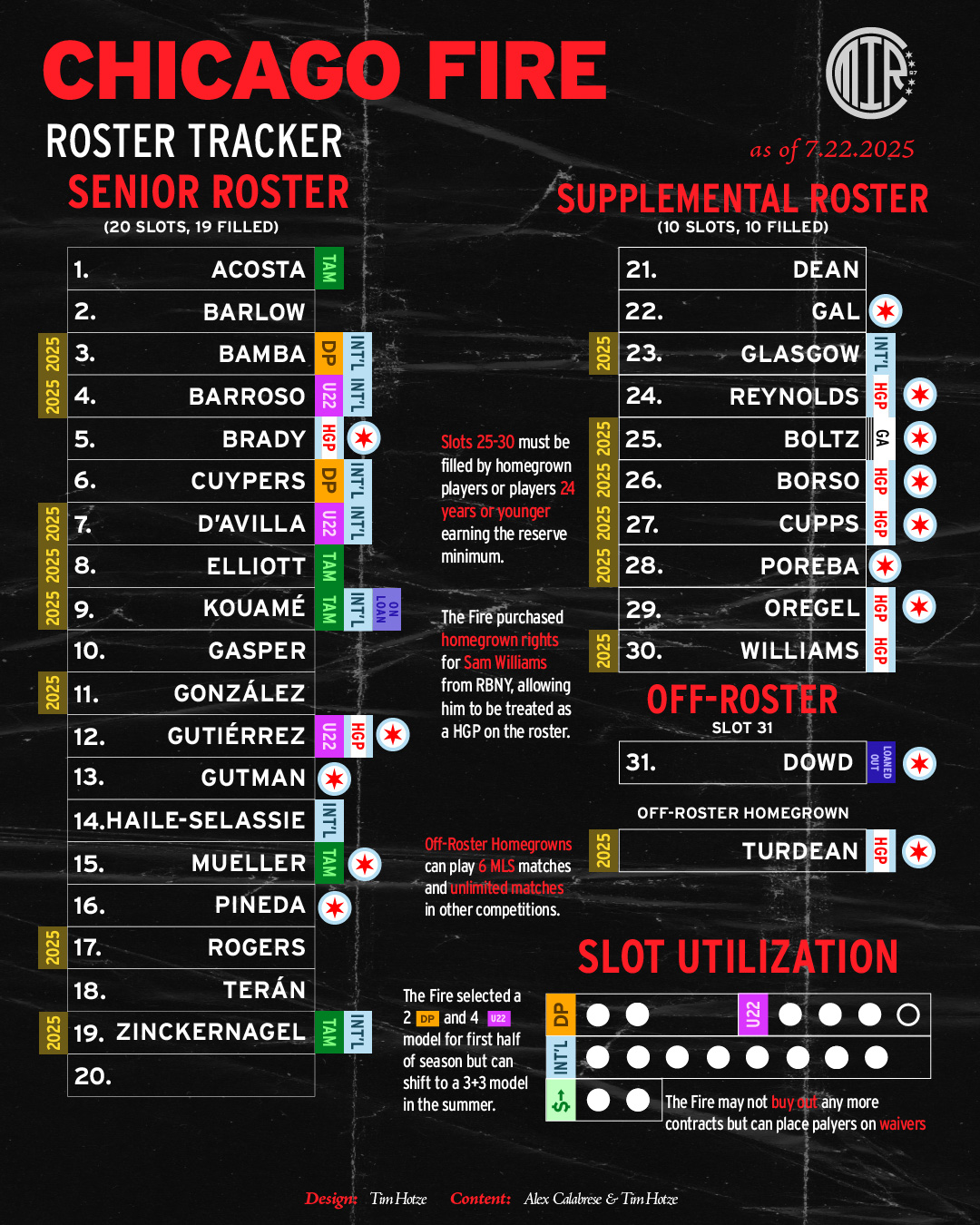
With that out of the way: Here’s the current state of the Fire’s roster, along with what it means. (For those curious about how to read this and who want to get into the nitty-gritty, we’ll have a comprehensive explainer of the roster tracker up soon.)
How many players can the Fire add?
At present, the Fire have one available roster space. The spot is on their senior roster, which has the most flexibility in terms of the player that can be brought in.
How can the Fire open up roster spaces?
For the Fire to sign more than one player, they will need to free up roster spots. That can be done by trading players within MLS, selling players abroad, or loaning the player – so long as the loan covers the player’s salary cap hit.
MLS teams can also clear roster spots a few additional ways. Teams have two buyouts per season, but the Fire have used both: One for the mutual contract termination with midfielder Gastón Giménez in the offseason, and the other on Arnaud Souquet, who was placed on waivers. The buyouts clear both the roster space as well as the player’s salary cap hit.

The Fire can still unilaterally decide to place a player on waivers, making them available to all other MLS teams. This removes the player from the roster, but unless the player is claimed off waivers, the team is still on the hook for their full salary cap hit.
Mutual terminations are also an option. In a mutual termination, the team would agree to pay some fraction of the player’s remaining salary and the player would become a free agent. Whatever portion the team is on the hook for, however, still hits the salary budget.
Teams also have one season-ending injury per season. Putting a player on the season-ending injury list clears their space on the roster, including special designations like international U22 Initiative players, and their cap hit. However, the player would not be allowed to play in any matches for the remainder of the season. The Fire have not used this spot in this or in other recent seasons.
What is the Fire’s salary cap position?
The short answer is: we don’t know for sure but in general, not great.
Unlike other sports, players’ exact cap hits are not public, nor are teams’ precise cap positions. Although the league has been moving towards greater transparency in recent seasons, much remains behind the curtain – something sources have told MIR97 Media is due in part to the fact that MLS is part of a global market for footballing talent, unlike other leagues which are typically the apex of their sports and offer pay far in excess of what other leagues can.
One move towards transparency has been making the amount of General Allocation Money (GAM) public. GAM is one of several accounting mechanisms used by MLS to allow teams to spend beyond the nominal salary cap. As of the most recent salary release date on May 1st, the Fire had $209,661 in available GAM.
That is not the whole picture, however: GAM is just one of two forms of allocation money. The other is Targeted Allocation Money (TAM), which has more restrictions on its use. Team TAM positions, however, are not public.
How can the Fire improve their salary cap position?
MLS teams can trade GAM with each other in exchange for other considerations, typically players, draft picks or international roster slots.
When players are sold, whether within MLS or abroad, teams can also convert up to $3 million per season into additional GAM.
Players placed on loan with another club would have the same effect. If loan fees cover the player’s entire salary cap hit, then that would also free up the player’s roster spot. That’s the case for forward Georgios Koutsias, loaned to sister club FC Lugano for 2025.

Finally, teams are allowed to select one of two roster construction paths. This year, the Fire elected to have two Designated Player (DP) slots and four U22 Initiative slots, which comes with $2 million in additional GAM. The team elected to take just half of that, giving them the flexibility to switch to a model with three DPs and three U22 players in the summer.
If the team decides to remain on the two DP roster construction path, they have an additional $1 million in GAM to spend this season.
Can the Fire add a Designated Player?
Yes – but it will be tight. Although the salary cap hit of DPs like Jonathan Bamba and Hugo Cuypers is significantly curtailed compared to their actual wages, the Fire’s tight cap position presents some challenges.
MIR97 Media understands that the team is confident they could add a third DP if they chose to – in fact, the rumors around the Fire’s pursuit of Belgian international Kevin de Bruyne occurred after the team’s most recent roster changes and the league’s GAM release – but it would likely put the team hard against the cap, barring additional roster changes.
Are there other restrictions on players the Fire can add?
At present, the Fire have used all eight of their international slots, meaning they would need to trade for an additional spot to sign a player unless a spot is otherwise freed up to be able to sign a player without a U.S. passport or permanent residency.
While international slots are typically traded for GAM, especially considering the team’s limited GAM reserve, they might choose to get creative – draft picks, other considerations, and even possibly GAM from future seasons could conceivably be the currency the Fire use to get a slot from a team that has one available.
If the Fire move a player off their roster – by trading him within MLS or selling him abroad – the spot would be cleared. The team would also clear the spot if a player completes their permanent residency (green card) interview prior to July 24th, however, the Fire have not announced that any of the eight players who currently occupy those slots have done so.