Fire vs Charlotte: Tactics and Starting XI

The Fire are back home for the first of two matches this week. Looking for just their third win of the season – and first in more than a month – the team’s first midweek match of the season comes against Charlotte, a team that has been humming under new Head Coach Dean Smith (no, not the famous Tar Heels basketball coach who passed away a decade ago).
Despite the team’s record – with five wins and 17 points after 12 games – there’s still real questions about whether or not Charlotte’s roster build has what it takes to truly compete at a high level in this league.
Although Charlotte are ahead of Columbus in the standings, the Crew have a game in hand and – with all due respect to the team from North Carolina – Wednesday’s match figures to be the far more winnable for the Fire, who could very much use the three points.
That’s especially true considering Charlotte’s Jekyll-and-Hyde-like home vs. away record: Although the team is 5W-2D-5L overall, all five of their wins have come at home and they’ve notched a single point on the road, going 0W-1D-4L so far this season.
Charlotte
Overview

Charlotte finished 9th in the Eastern Conference both of their first two seasons in the league, but last season, that was enough for a wildcard berth in the postseason due to the league’s expanded playoff format.
From the team’s entry into the league, there have been real questions about the team’s roster build and identity. Shortly before the start of their inaugural season, original head coach Miguel Ángel Ramírez made headlines around the league by saying that without additional signings, “we’re screwed.” With the team in eighth place and rumors of fractures between Ramírez and his players, he was dismissed at the end of May, just 14 games into the team’s existence, and replaced by Christian Lattanzio on an interim basis.
Lattanzio was given the full-time job in 2023, but the team failed to develop any kind of true identity on the pitch, and was shown the door despite making the postseason for the first time in team history (the team did lose 5-2 to the New York Red Bulls in their wildcard match).
Looking to right the ship and develop a tactical identity for the team, they brought in then-52-year-old Dean Smith in the offseason. Smith had previously served as manager of a number of English clubs, including Brentford, Aston Villa, Norwich City and Leicester City.
The results have improved under Smith, and the team is now sitting in fifth place in MLS’s Eastern Conference, but concerns about the roster build remain.
DP Troubles

At the forefront of concerns about Charlotte’s roster: Finding Designated Players (DPs) that can give them real production. Karol Świderski, the team’s first-ever DP signing, produced at an adequate, but not stellar level. He lead the team in goal contributions in 2023, but was rotated through attacking possessions last year under Christian Lattanzio.
Looking for consistency, he asked for a move, and is currently on loan to Italian side Hellas Verona, opening up the DP spot. Fellow Pole Kamil Jozwiak, however, was a disaster of a DP signing on a scale familiar to Fire fans: He scored just two goals in his two years in MLS, and was unceremoniously let go in the offseason.
Adding insult to injury: Argentinian Striker Enzo Copetti was brought in to improve the team’s production last season, and had significantly underperformed, with just six goals and two assists in just under 2000 minutes last year. Rumors are swirling of his imminent departure back to Argentina, where he was a prolific scorer before joining MLS, with the opening of Argentina’s window coming in less than a month.
The team brought in Israeli attacker Liel Abada from Scottish side Celtic in the offseason as a Young Designated Player, and just as it looked like he might be settling in, he injured his leg, and hasn’t played since their 2-1 loss to New York City FC on April 27.
They’ve been snakebit with DPs. With Copetti gone, they’ll have a spot open this summer but given the team’s hit rate – and unwillingness, so far, to really spend high with their DPs – it’s really a roll of the dice whether Copetti’s replacement will be an improvement this summer.
What Dean Smith Has Changed
Without reliable high-end attacking talent, Dean Smith has opted for a pretty standard 4-2-3-1 or (more recently) a 4-3-3 that routes the attack mostly through the wings.
It’s worked, but the team hasn’t exactly been chasing any scoring records, with 13 goals in 12 matches, but they’ve also been stingy the other way, allowing an equal 13 goals.
Statistically, however, the team’s expected goals against (xGA) is the second best in the league at 12.3, according to FBRef. That’s because they’ve largely been able to keep the shot numbers against down: They’ve allowed just 128 shots against, averaging out to just 10.67 shots allowed per 90 minutes – second-fewest in the league after Columbus. That comes despite the fact that, unlike the Crew, Charlotte lets opponents have the ball: They’ve got just 46.3% possession, good for 25th in the league in that department.
They’re just recovering the ball before teams can get shots away. So far, everyone on Smith’s squad seem dialed-in, and it’s been enough to earn the team points, particularly in front of the home crowd.
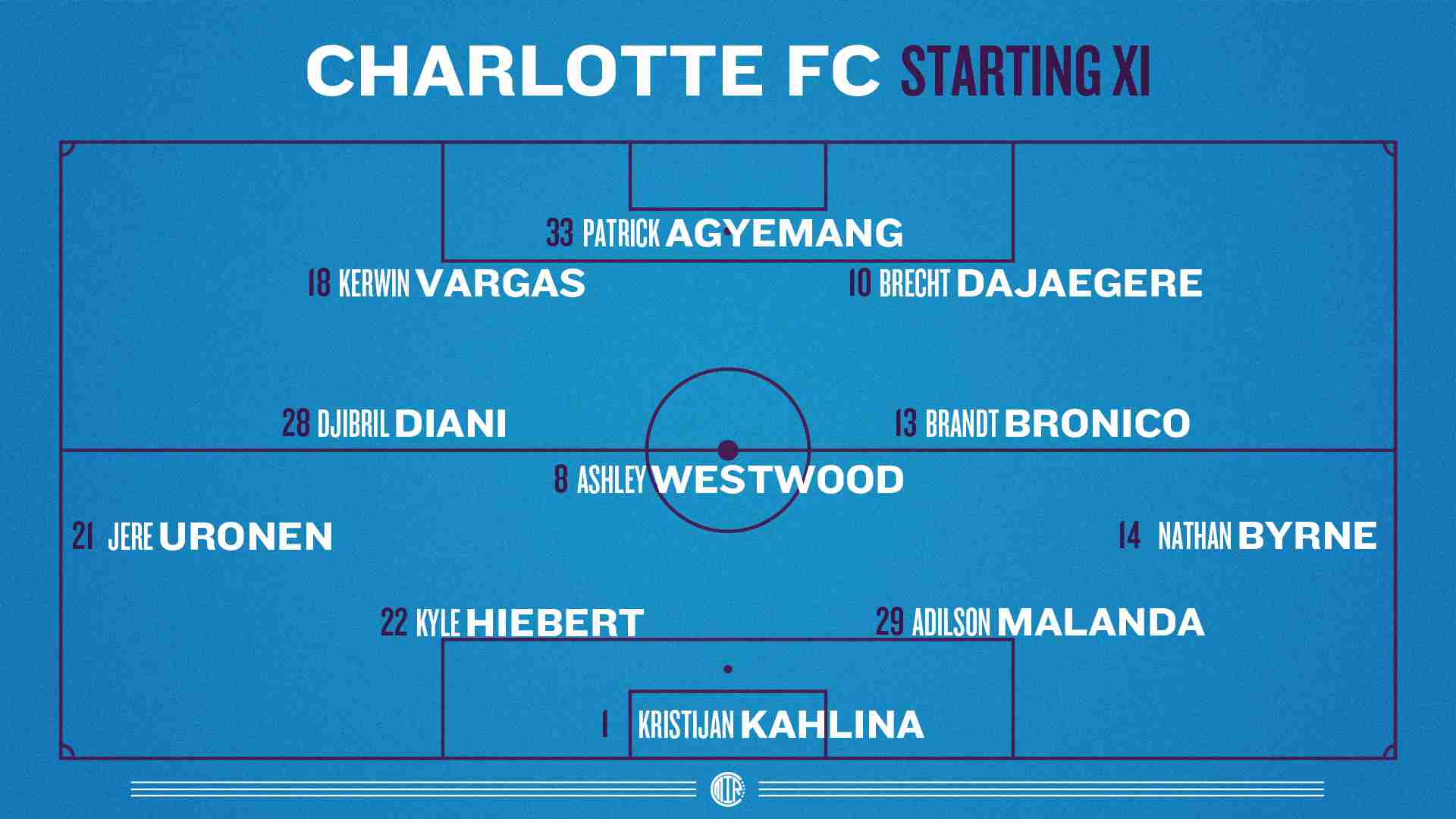
Charlotte's Formation and Starting XI
Smith has been pragmatic with his formations, and before the season, he said “I can sit here and say my playing philosophy is the same as Pep Guardiola’s or Jurgen Klopp’s, but we haven’t got their players. So my playing style has always been, if we lose the ball, win the ball back quickly and go and score as quickly as we can. And if we can't, then we retain possession and find different ways to score.”
That’s more or less what they’ve done. Press – though not nearly as much or as fast as St. Louis – play against the ball, and use fast, direct play through the wings to start the attack.
Nominally, Smith’s teams have been playing out of a 4-2-3-1 or a 4-3-3, but in practice the two formations have been pretty similar, with the attack building up through the wings rather than centrally. Since Copetti has fallen out of favor, the team’s favored a 4-3-3, since it essentially de-emphasizes the frontmost central attacker. If you don’t really have a striker you believe in, play a system that has a three up top instead of one.
That isn’t to say that Charlotte don’t have attacking talent:
https://twitter.com/MLS/status/1789459784451674450
That’s 23-year-old Patrick Agyemang scoring a banger for Charlotte on Saturday. The thing is, Agyemang, a 2023 MLS SuperDraft pick for Charlotte, isn’t just a finisher, which is why I said the 4-3-3 may be a better fit than the 4-2-3-1: As Matt Doyle pointed out in his column this week, he’s top 10% in the league amongst forwards for progressive carries and successful take-ons, and partly as a result, also top 10% for touches in the box.
Not bad for a guy making the reserve minimum ($71,401) this year. Alongside him, Belgian midfielder Brecht Dejaegere and U22 initiative player Kerwin Vargas have become the preferred options with Abada injured.
Further behind them, expect former Fire player Brant Bronico to start alongside team captain Ashley Westwood and 2024 addition Djibril Diani. The trio are a key part of why Charlotte have been so miserly on defense.
On the back line, Jere Uronen, Andrew Privett, Adilson Malanda and Nathan Byrne have all been virtual locks at starting positions ahead of GK Kristijan Kahlina.
Chicago Fire
One Down, A Lot More To Go
The Fire ultimately lost against St. Louis, but they did something they haven’t in recent matches: Score a goal. It came off Hugo Cuypers foot, with the Belgian striker doing an excellent job getting the right angle on his one-timer. That’s exactly what you want your top striker to do: Execute when given the opportunity and make something difficult look remarkably simple.
That strike in the 46th minute ended the Fire’s goalless drought at 417 minutes – three minutes short of seven hours and by far the most in the league this season, but it came when the Fire were already down a goal.
It’s great that Cuypers got involved; scoring doubtless helps his mentality and that’s valuable currency for strikers, but scoring a team that scores one goal every five games shouldn’t expect many results.
One Way Not To Blow A Lead

In previous years, a common complaint about the Fire was their propensity for blowing leads. Well, the 2024 edition of the team has found one solution: Just don’t get the lead in the first place.
After 12 games – and 1,080 minutes of regulation soccer – the team has held the lead on just four occasions across three matches during regulation, for a total of 117 minutes (the Fire managed a win against CF Montréal, but did never lead until deep into second half stoppage time).
That means the team has been ahead just 10.8% of the time in regulation, with more than half of that total (67 minutes) coming against the Dynamo. That’s the only match where the team has managed to get ahead in regulation and win – leads against the Union and Revs evaporated and the team had to settle for draws in both matches.
The lack of leads shouldn’t be surprising considering the team failed to score in five of their 12 matches, but it also shows how the team’s struggles on both sides of the ball are connected: Failing to get ahead means that opponents are almost never chasing the game, having to commit more numbers forward than they’d prefer to in search of an equalizer.
That, in turn, makes offense harder. The Fire are making everything harder on themselves by not getting leads early. Before the match in St. Louis, Fire Head Coach Frank Klopas said the game plan was to withstand the initial 15-20 minutes of St. Louis’s attack, saying “in the beginning, it will be a little bit hectic and we have to be ready for that. I think once the game settles... There are opportunities where we definitely can play.”
That all went out the window when the Fire conceded in the 2nd minute, meaning the team was chasing the game – and letting St. Louis sit back and try to get more goals off counters, while the Fire had to push hard to regain their footing.
The plan against Charlotte has to involve taking the game to them from kickoff, particularly at home against a team that’s winless outside of their own building.
Be Prepared for Wide Balls
Klauss’s first goal came because he was left unmarked in the box. There were multiple players near him, but none on him. Whether that’s a failure of planning (doubtful; he’s their one high-end offensive weapon) or execution (more likely), it’s the kind of thing that Fire players should have been prepared for.
Klauss’s second goal came when Arnaud Souquet was beat, allowing for the ball to be played into the box - this time, without Fire defenders in the box, which, depending on your perspective, either makes things better or worse.
The team allowed Indiana Vassilev to cut through Fire lines so easily that it made him look like Lionel Messi – and if his targeting scanners were as accurate as the Argentine’s, he’d have had a couple of goals himself.
Regardless: St. Louis played the way you’d expect them to play; they executed their game plan and the Fire didn’t have answers for it.
Against Charlotte, they need to be prepared for the ball to be played into the defensive midfield then out to the wingers, who will either cu in, or, more likely, try to feed Agyemang, who’s capable of getting the ball into dangerous areas himself.
The Fire need to be prepared for long balls into the wide areas defensively, and iud they are – and if they can stay up to their marks – then they should be able to contain Charlotte’s milquetoast offense.
How Will the Fire Line Up Against Charlotte?
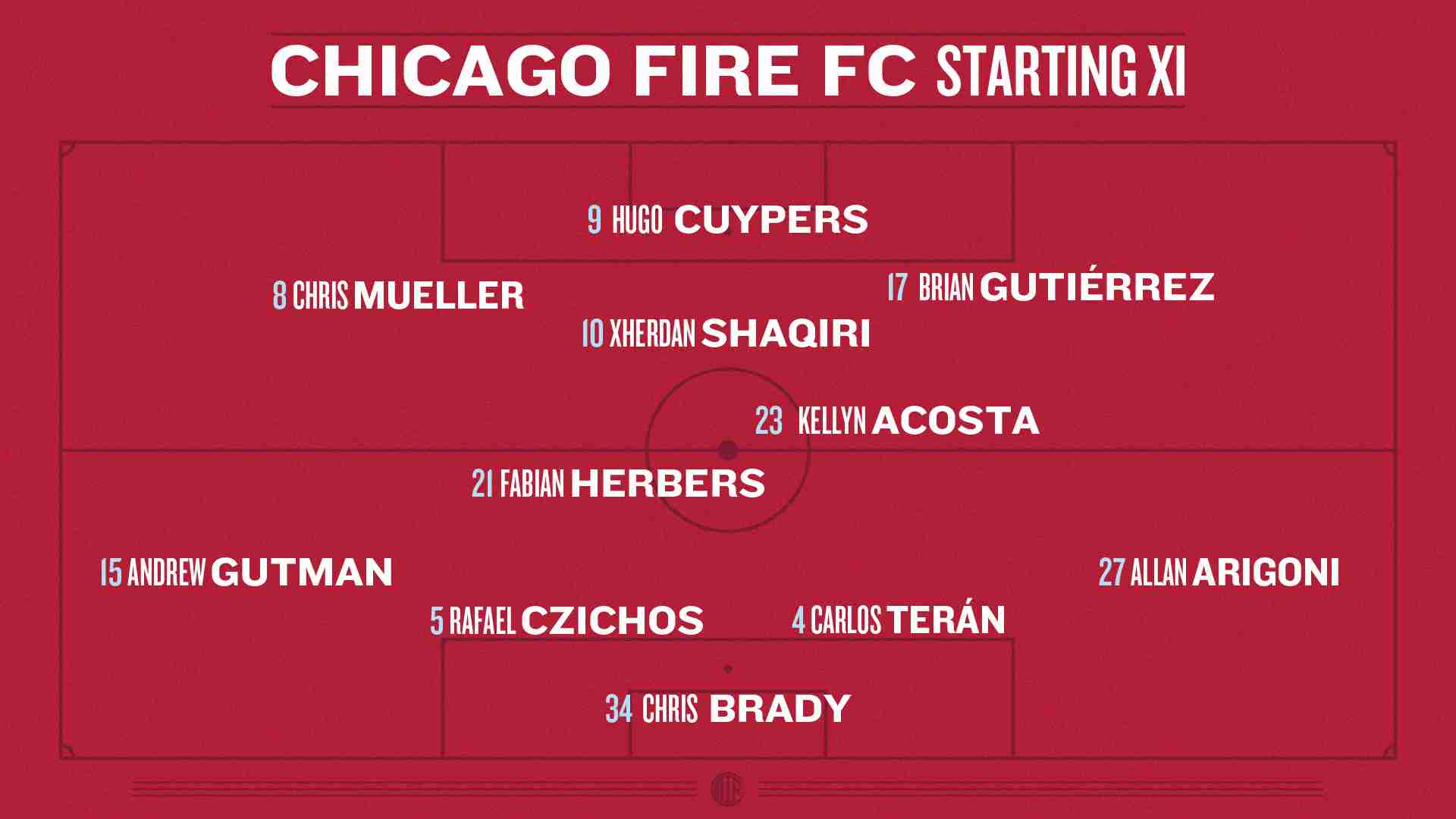
I predicted that the team would return to its normal 4-2-3-1 shape against St. Louis, and hey, I was right. I was wrong, however, about where Brian Gutiérrez and Chris Mueller would play, predicting that Mueller would stay in his natural position on the left, and Gutiérrez would play on the right.
The result speaks against St. Louis volumes about the results of that experiment. It needs to be reversed, and Gutiérrez needs to be allowed to roam and play centrally, distributing the ball to Shaqiri, who should be allowed – expected, even – to drift wide.
Last week, I also presumed that Rafael Czichos would be ready to start – I was wrong, and instead he came in off the bench to relieve Mauricio Pineda who was given the nod instead. It seems that Czichos is still the preferred option there, however, and with a few more days of recovery, it’s likely he’ll be back starting.
Unfortunately, both Kellyn Acosta and Allan Arigoni picked up minor knocks in St. Louis, and are listed as questionable for the game, but I think if they’re at all ready, Klopas will press them into service against Charlotte: This is a highly winnable must-win match, and you need your best XI, even if they’re a little bit shy of 100%.
Somehow – and this is based on absolutely no inside information – this feels like the kind of match where Klopas throws out a new formation with untested lineup combinations. This – and I cannot stress this enough – would be a mistake. The Fire’s problems are more about execution and tactics, not about individual players or formations, and changing the formation does nothing to solve that issue.
Similarly, while some lineup rotation is inevitable with two games in a week, this isn’t the game to do that: Giving anything but the best shot possible to win this game just to be able to play Columbus a bit closer would be both a strategic and tactical error.
This is a winnable game against a team that has just one point on the road, and the Fire need to win now, before they worry about Saturday.