Fire vs D.C. United: Tactics and Starting XI

The Fire are facing D.C. United, a team that has a lengthy history with the fire, in their first of two games this season at SeatGeek Stadium, the team’s home for 14 years.
The teams own the two longest active playoff droughts in the league (the Fire, six seasons; D.C., four), a streak that both teams would like to break. With seven games remaining, every three points are critical, and the Fire, whose last victory came in mid-July, would love to get a win against a conference rival.
Note: For a more general overview of D.C.’s tactics and style of play, check out the tactical preview from the first game of the season between the two teams in May, available here.
D.C. United
Pressing to Change the Team’s Fortunes
In the offseason, D.C. United brought in Troy Lesesne as head coach after his contract with the New York Red Bulls, where he had been serving as interim, was not renewed. The move came as D.C., who currently own the league’s second-longest active playoff drought after the Fire, look to turn the team’s fortunes around.
On joining D.C., Lesense was quick to say that his strategy wouldn’t simply be a Red Bull-style high-press-and-counter gameplan. Most of the way through the season, DC. have… been playing a high press and counter system, much like the New York Red Bulls.
Actually: They’re playing Red Bulls-style soccer more than the Red Bulls these days. They have the second shortest attacking sequence time in MLS, at 7.83 seconds, behind only St. Louis City SC, and almost a full second briefer than the Red Bulls at 8.82 seconds. They also have the second fewest passes per sequence (again, behind St. Louis), and third highest direct speed, behind St. Louis and New York City FC and tied with Los Angeles FC (all data from Opta).
If you can get buy-in, energy drink ball is a good way to raise a team’s floor: It’s why the Red Bulls have made the playoffs every year from 2010 onwards, even as many of those teams have been at talent deficits compared to some of their rivals. Press, create turnovers in dangerous areas, then you’re off to the races.
https://twitter.com/MattDoyle76/status/1830291715720364425
Look, when it works, it works.
Benteke alone can’t keep D.C.’s head above water solo

Yet D.C. United currently sit in 11th place, out of the playoffs and are the less-than-proud owners of a negative 14 goal differential, despite having a legitimate contender for the MLS Golden Boot on the squad in Christian Benteke.
Here’s the thing, though: One player does not a team make, and although Benteke has 17 goals, no one else on the squad has more than three. In fact, whether or not you include secondary assists, more than half the team’s offense has come from Benteke.
And although so far, he has looked ageless, he’s turning 34 years old later this year and although he’s been out for a couple of games for various reasons, of the 23 games in which he’s been available, he’s played 1,993 of the 2,070 minutes. Lesesne can’t afford to sub his star player off, and that could cause real problems with D.C. needing every point it can get down the stretch.
Lesesne just doesn’t have options on his bench that he trusts to help with the offense, nor does he have a strong secondary scorer to play alongside Benteke.
D.C. United Starting XI Prediction
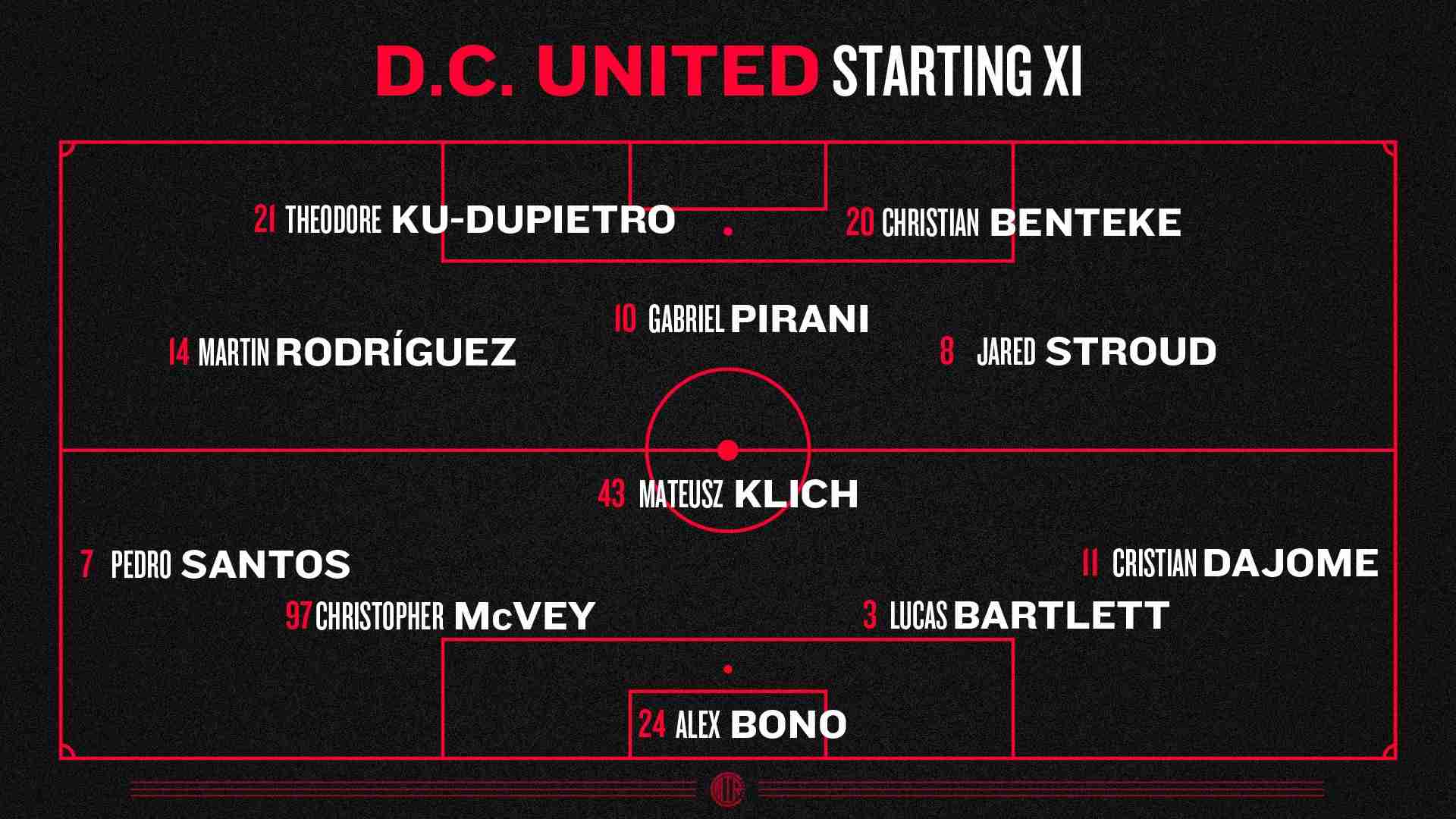
Actually, this week, he doesn’t have a lot of options, period. Boris Enow, Aaron Herrera and Matti Peltola, all of whom project as starters, were called up to international duty, and they’ve had six players out with injury, five of whom are expected to remain unavailable for this match.
With most teams, this would be the time to call in players from MLS Next Pro on short term agreements, but D.C. United doesn’t have a Next Pro squad. So, D.C. have the players on their roster, and the call ups and injuries are what they are.
This creates cascading problems throughout the roster, and the Lesesne doesn’t really have match-proven subs available at any line for this one.
In fact, the team doesn’t really have a central defensive midfielder available at all, with Enow, Russell Canouse and Matti Peltola all unavailable. With D.C. lining up in a 4-1-3-2 for the past couple of games, with a sole, deep-lying midfielder as the “1,” that’s a problem.
One option would be to deputize homegrown Jeremy Garay, but he has all of nine minutes in MLS to his account, so trusting home with 90 seems unlikely. Instead, it’s likely that Mateusz Klich will drop deeper and play in the role. Klich has eight assists on the year, second on the team to Jared Stroud, but five of them have been secondary assists: He’s a pass-before-the-pass guy, and playing him deeper – and trusting the veteran player to know when it’s safe to push up and join the attack – is likely the best option available.
The team’s also short on the back line, and doesn’t really have anyone to relieve Benteke if the game is still on the line, but there’s only so many problems a coach can solve. It isn’t entirely accurate to say that the weight of the team is all on Benteke, but he’s going to be asked to carry the lion’s share of the weight in this one.
Chicago Fire
Good decision-making “No. 1 thing” to beating D.C.

Here’s the scouting report on D.C. United, according to Fire Head Coach Frank Klopas:
Without the ball they are aggressive with Estrada on one side, Di Pietro on the other. If you try to build out play, they are very aggressive pressing with the wingers, their wingbacks step really high up. Our decision-making and understanding where pressure is coming up, that's the No. 1 thing, how are they pressing us, in order to find solutions to break them down, but also our ability now at times to break that pressure when they are stepping off and they are very aggressive, we are going to have opportunities in 1v1 situations against their backline.
So it's about good decision-making and not forcing the ball in bad areas, understanding where the pressure is going to come when we have the ball. And obviously, without the ball, second balls become really important, being good defensively with set pieces. They’re a team with height, they are dangerous in set pieces, and doing a good job, obviously, on Benteke.”
Honestly, couldn’t have said it any better. The faster the Fire players understand what D.C.’s pressing triggers are, the better. Although they have a direct, high-speed attack, the roster isn’t actually one of the stronger in the league in terms of a straight out foot race: Instead, they rely on their high-press to get them the ball in the offensive half of the field, and if they lose it, they’ve got plenty of space – and therefore time – to recover.
If you can win the ball back, you can find yourself in an advantageous position going the other way, especially with faster, direct play.
Let the kids cook
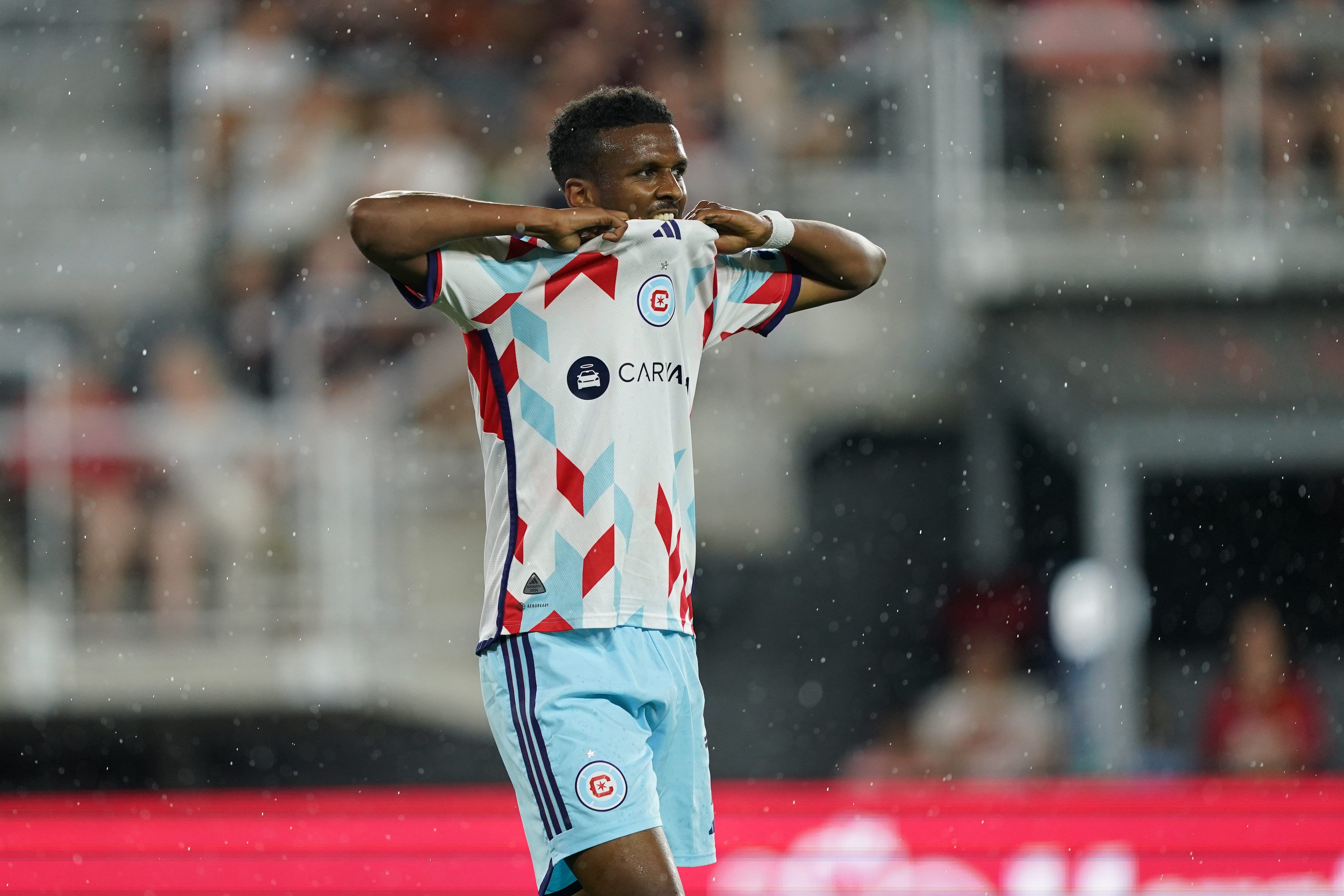
Georgios Kousias had been on a tear of late, notching his third goal in four games, and earning a call up to the Greek youth set-up. (Curiously, of the six goals Koutsias has scored since joining the Fire, only one came as part of a winning effort, the 1-0 victory last September over the New York Red Bulls.) Ari Lassiter was also called up, and Rafael Czichos – who scored the Fire’s lone goal against Miami in Ft. Lauderdale – is suspended due to yellow card accumulation.
As a result, the Fire will be without two of the four players that scored for the Fire between the Fourth of July and Labor Day, putting more pressure on the other two – Hugo Cuypers and Brian Gutiérrez – as well as Maren Haile-Selassie, whose 12 goal contributions (five goals along with seven assists) tie him for the team lead in that department with Cuypers and who set up Koutsias’s goal last week.
Almost on cue for a big game at this point, Gutiérrez looked good against a strong opponent, but, at the same time, despite some strong play in segments, didn’t ultimately take over the game. Against Miami, that have been an unreasonable expectation, but it isn’t against D.C.
With Xherdan Shaqiri gone, the keys to the attack are in Gutiérrez’s hands, and the Fire will go as far as Guti takes them – the issue has been, despite stronger play of late (he scored a PK against New York City and assisted on both goals the Fire scored in the Leagues Cup), that hasn’t been far enough for wins on a regular basis.
Without other teams feeling like Gutiérrez is a true threat, too much of the offense is either coming from Cuypers making his own chances or balls to the wings areas before the Fire hit a cross. Routing the attacks entirely through wide areas makes the Fire too easy to defend against. The door is open for Gutiérrez to become a high-impact player in this league; he’s got his foot in the door, but he needs to fully step through and he just hasn’t yet. If he does, starting against D.C., the Fire can beat the odds and make the postseason.
Chicago Fire Starting XI and Formation Prediction
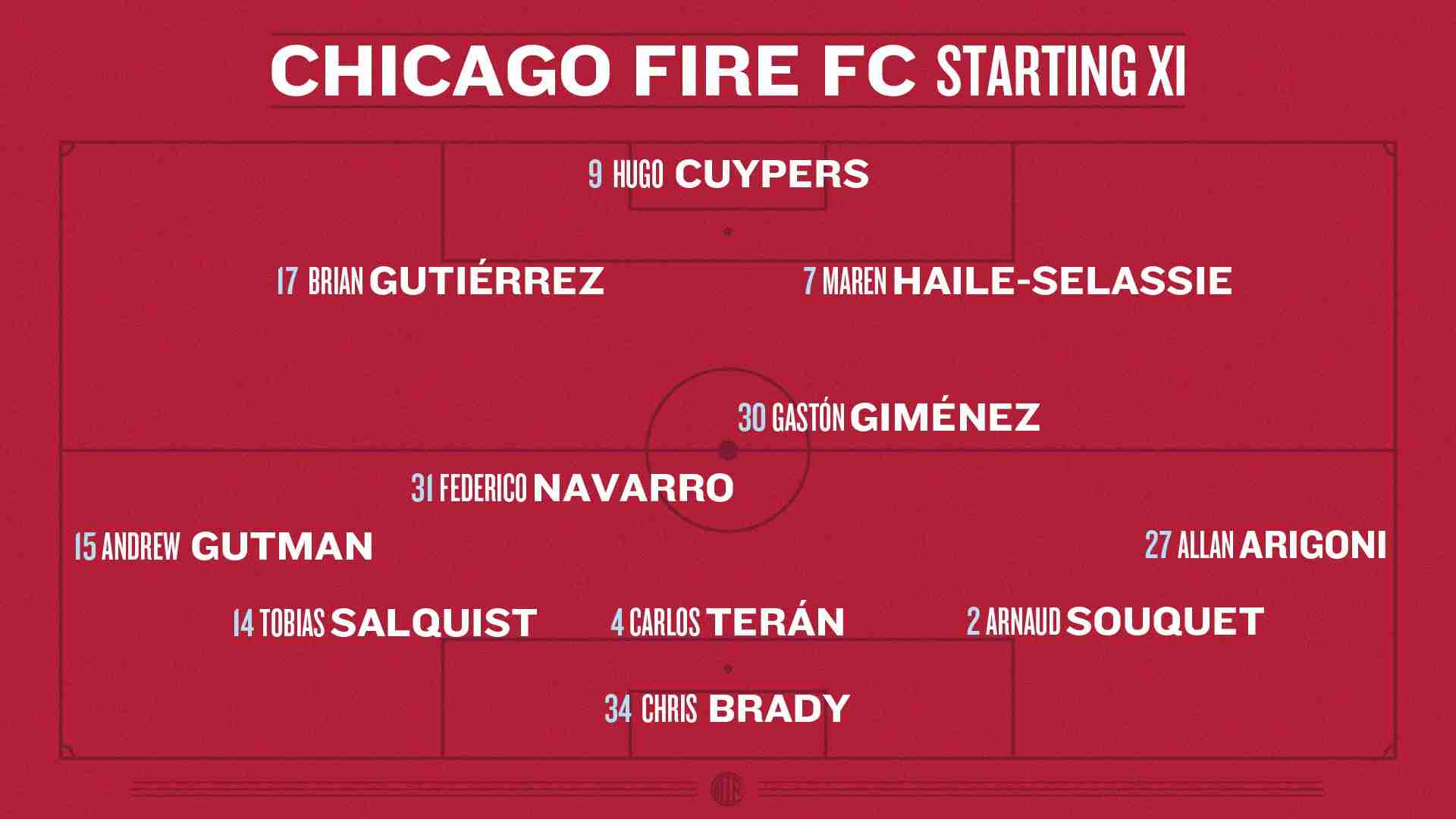
Against Miami, Klopas lined up the team in a 4-1-2-1-2, with Gastón Giménez as the deep-lying midfielder and Gutiérrez up top, with Federico Navarro and Chris Mueller in between them. My bet is that it was an attempt to deny Luis Suárez opportunities to score by clogging up the center of the pitch.
It obviously didn’t work out that way, and it also meant that the team, whose offense has often depended on getting balls wide (see above) were in a very narrow formation going the other way.
Against Miami, in what didn’t feel like a home crowd, maybe playing defense first and just hoping for luck the other way made sense, but at home against D.C., it doesn’t, l and suspect that the Fire will revert to some variation of a 3-5-2.
In the back line, with Czichos out, that means giving Tobias Salquist, Carlos Terán and likely Arnaud Souquet starts, particularly with Mauricio Pineda just working his way back from injury. Salquist has just been snakebitten too often: he’s had two long-term injuries this season and he wasn’t out of position when Brady’s save ended up ricocheting off his face for an own goal. He’s due for a rebound. Hopefully, he gets it.
In the midfield, for whatever reason, despite playing well against Miami (and getting the assist on Koutsias’s goal), it seems that Kellyn Acosta may be out of the starting rotation again. Federico Navarro, on the other hand, played well against a team that includes a number of his countrymen. Going back to the game against Toluca, he’s started to look a lot more like the player with a lot of promise that we saw early on in his Fire career (heck, he even managed to get yellow cards against both Toluca and New York City FC).
It’s a welcome sight, and he deserves a look in the XI.
The Fire may have a twelfth man as well: While Soldier Field has some notable improvements over SeatGeek (location, for starters), even when the Fire get healthy crowds of more than 25,000, the stadium design (it’s sheer size, lack of roof to keep sound in, distance from the seats to the pitch) has often made it hard for the crowd to really contribute to the team. At SeatGeek, as Frank Klopas noted, “When you get 10,000 people [at SeatGeek], the atmosphere becomes really great, it’s a different vibe… I think it’s good to play this game where we can have our fans right on top of us so we can create that great atmosphere we sometimes miss.”
If the atmosphere helps propel the team to victory, they leapfrog ahead of D.C. in the standings and within striking distance of a postseason spot.