Looking to expand audience, Chicago Fire announces MLS Season Pass offer

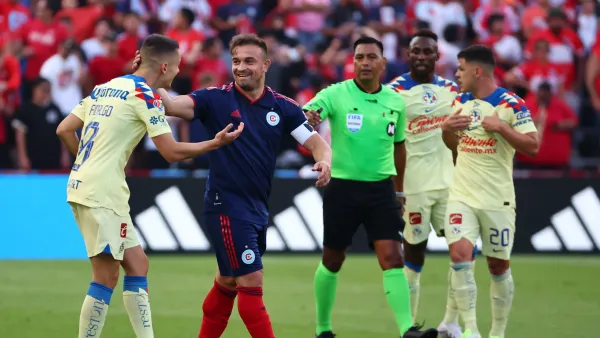
In 2025, the Chicago Fire have played a brand of fun-to-watch soccer and the results have also picked up: The team’s 42 points eclipses the total they’ve had any year since the 2017 season, the last year that the Fire made the playoffs. Although the Fire have continued to draw some of the best crowds that they have in the team’s 28 seasons, sharing the team’s improved form with fans and casual sports-watches who may not have wanted to purchase a ticket has been a challenge with the vast majority of the team’s matches behind a paywall on MLS Season Pass on Apple TV.
To help address that visibility gap, Chicago Fire announced a promotion providing access to the team’s final five games of the regular season as part of a one-month free trial to MLS Season Pass on Apple TV. The promotion expands access to the team’s games on the streaming platform as the Fire look to secure their first postseason berth this decade.
According to the terms of the promotion, fans can text the code FIREUP to 24258 to receive one free month of MLS Season Pass, which they can access via their TV, computer or iOS or Android device. The promotion has no cost, but if users do not cancel the promotion, they will be charged the going rate for MLS Season Pass after that date.
The change is one of a number of moves made to expand access and visibility of MLS as a broadcast product after the league went all-in on streaming in a landmark Apple TV deal that began in 2023.
Renewing a deal from that inaugural year but absent in 2024, T-Mobile announced that most of their customers would be eligible for a free MLS Season Pass subscription. In addition, at the start of the season MLS announced deals with DIRECTV and Xfinity that would enable customers to purchase MLS Season Pass directly through those TV providers, typically enabling access through both the Apple TV app as well as a channel accessible on their set-top box.
The deal with Xfinity went a step further, providing free access to MLS 360, the league’s whip-around show, every Saturday. In May, Sunday Night Soccer was added to the deal.
The Chicago Fire are one of a handful of teams throughout the league that have also announced deals that put tape-delayed games on local TV channels several days after they are played. The Fire’s partnership with Marquee Sports Network, best known for as the Chicago Cubs broadcaster, also includes Inside the Fire, a bi-weekly program including highlights and interviews.
This move enables the Fire to remove money as a barrier to access for the team’s final matches of the regular season. That may be particularly beneficial to the Fire, who have a large base of fans whose once-passionate interest in the team has waned in recent years with the team’s lackluster results on the pitch, having last won a playoff game in 2009.

Still, this move and the other changes seen this season still require more proactive action from the consumer’s part. Teams’ visibility in their local markets has often been hampered by the league’s decision to end local broadcast deals, such as the one that the Fire had with WGN-TV from the 2020 through 2022 campaigns. (A handful MLS games, including the MLS Cup final, have also been available on traditional linear TV networks.)
Although streaming accounts for a growing fraction of TV viewership in the United States, Apple TV has significantly lagged other platforms in viewership and paid subscriptions. In the most recent data available from Nielsen, Apple TV was not one of the top nine streaming platforms in terms of hours watched, with a behind Warner Bros. Discovery’s 1.5% of total hours watched, split between Discovery+ and HBO Max.
That fundamentally creates friction between consumers and any content on Apple TV in a way that didn’t exist in years past with linear broadcast partners (although access to those has also become limited, particularly amongst younger demographics coveted by marketers as cord-cutting has become more popular).
Still, amongst those who have access, MLS Season Pass has been popular. Making every game across the league available in one place has made it easier for hard-core fans to watch more matches.
Writing at The Athletic, Paul Tenorio cited internal league data stating that as of the end of the last season, “more than one million people watch MLS games on an average Saturday across all games, that around 94 percent of subscribers feel Season Pass is “significantly” better than previous broadcasts.”
Before the Apple TV deal, quality varied around the league, with a number of teams matches only available in 720p resolution, sometimes with one or two cameras. By contrast, all games on MLS Season Pass are available in 1080p and The Athletic has reported that broadcasts feature a minimum of 10 cameras.
That, and improved (though sometimes imperfect) color grading gives the league’s product a more professional sheen than it had in 2017, the last year that the Fire were in the postseason. The hope – from both the team and their broadcast partner – is that fans will like what they see enough to want to come back for more, something that is likely to depend far more on results on the pitch than camera quality.